

For most of the 20th century, intelligence meant one thing: how well you scored on a standardized test. IQ was the metric, and that was more or less the end of the conversation.
That view has always had a problem. It ignores the composer who hears a melody once and can reproduce it perfectly. It doesn’t account for the surgeon with an extraordinary awareness of their hands in space. It misses the person who can walk into a room full of strangers and, within minutes, understand the social dynamics at play. None of those abilities show up in an IQ score.
In 1983, Howard Gardner, a developmental psychologist at Harvard University, proposed a different framework: the theory of multiple intelligences. His argument was that intelligence isn’t a single trait. It’s a collection of distinct abilities, and most people are stronger in some than others.
Gardner originally identified seven types. He added an eighth in 1996 and proposed a ninth shortly after. Together, they explain why the same lesson can be immediately clear to one learner and completely opaque to another. It’s not because one person is smarter, but because they process information differently.
If you’re designing a course or training program, this is a framework worth knowing.
Skip ahead:
- The 9 types of intelligence
- How to identify your intelligence type
- Designing for multiple intelligences
- Frequently asked questions
The 9 types of intelligence
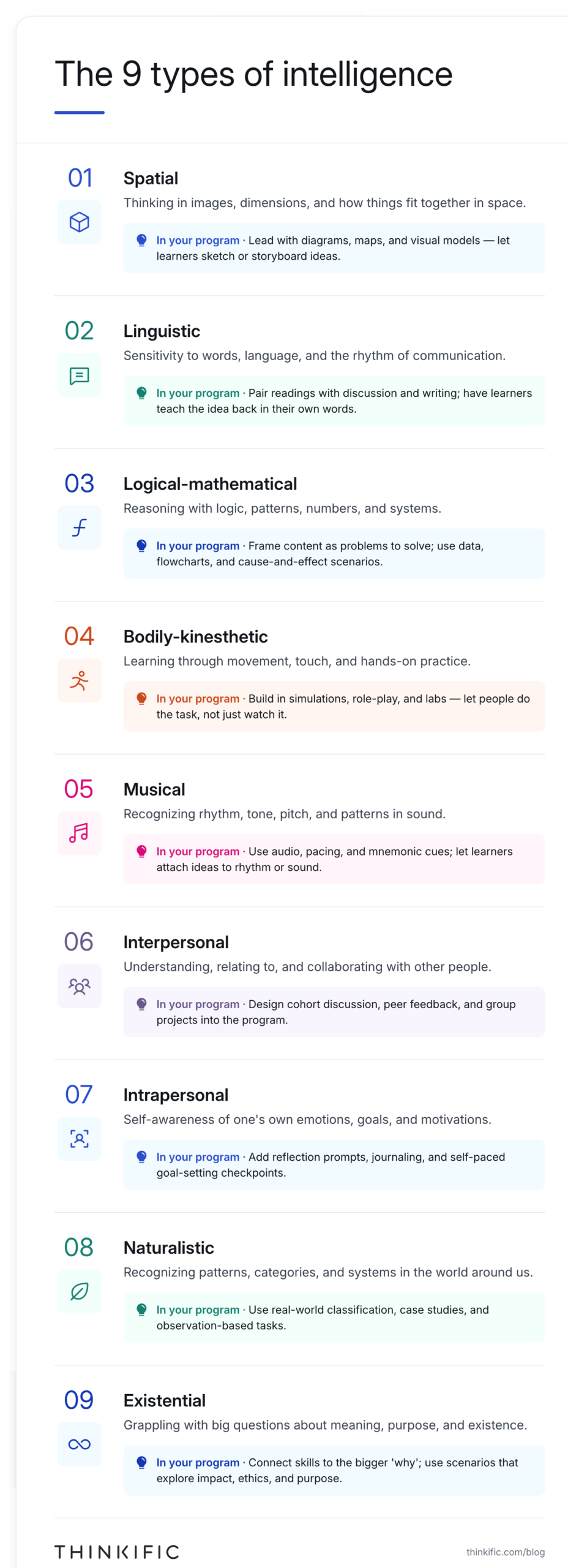
Gardner’s nine intelligence types are: spatial, linguistic, logical-mathematical, bodily-kinesthetic, musical, interpersonal, intrapersonal, naturalistic, and existential. Here’s what each one is, how that learner tends to absorb information, and what that means for course design.
Spatial intelligence
Spatial intelligence is the ability to think in pictures, perceive three-dimensional space accurately, and mentally manipulate objects and environments. Architects, engineers, surgeons, and visual artists tend to score high here.
These learners process information best when it’s shown rather than told. Diagrams, charts, models, annotated images, and video demonstrations all work well. A dense paragraph describing a spatial concept will lose them; a labeled diagram of the same concept won’t.
Teaching tip: When explaining a process that has a physical or structural dimension, lead with the visual. Put the diagram or flowchart first, then add the explanation underneath.
Linguistic intelligence
Linguistic intelligence is sensitivity to words: their meaning, rhythm, nuance, and relationship to each other. These learners read quickly, write with ease, and tend to think in language. They’re the ones who will actually read every word in your course.
They learn best through reading, writing, discussion, and any format that asks them to articulate what they know. Written course materials, discussion forums, and reflection prompts are a natural fit.
Teaching tip: Build in writing prompts or community discussion questions at the end of modules. Asking learners to summarize a concept in their own words deepens retention — and it especially works for this group.
Logical-mathematical intelligence
This is the type that standardized tests tend to measure. Logical-mathematical learners are strong at recognizing patterns, reasoning sequentially, and working through problems step by step. They gravitate toward structure, formulas, and cause-and-effect relationships.
They learn best when content is organized logically and there’s a clear framework to anchor new information to.
Teaching tip: Turn abstract concepts into systems. If you’re teaching a business skill, make the formula visible: input, process, output. This group will latch onto a model faster than they’ll absorb the same idea delivered as narrative.
Bodily-kinesthetic intelligence
Bodily-kinesthetic intelligence is the ability to control and coordinate physical movement and process information through the body. Athletes, dancers, physical therapists, and skilled tradespeople tend to have high bodily-kinesthetic intelligence.
This is the most challenging type to serve in an online course context. These learners absorb information best through doing, not watching or reading. Role-play scenarios, physical assignments completed outside the course, and practice-based challenges can help bridge the gap.
Teaching tip: Assign a physical practice between modules. “Before the next lesson, try this with your hands” is more effective for this group than another video. It gives them something to bring back to the course.
Musical intelligence
Musical intelligence is sensitivity to rhythm, pitch, tone, and sound patterns. These learners often process information more easily when it has a rhythm or structure they can follow. They tend to find poor audio quality more distracting than other types, and they may associate ideas with music or melody.
Narrated audio content, well-paced video, and content with a clear sequential structure all work well. Mnemonics and frameworks that have a rhythm to them also land.
Teaching tip: Invest in audio quality. For learners with high musical intelligence, unclear or low-quality audio isn’t just annoying; it’s a genuine barrier to comprehension.
Interpersonal intelligence
Interpersonal intelligence is the ability to understand and respond to other people accurately. These learners are perceptive about moods, motivations, and relationships. They tend to be natural collaborators and often learn as much from other people as from structured content.
Community-based formats are a strong match: discussion forums, peer review, group projects, live cohort sessions, and Q&As with the instructor.
Teaching tip: Build in social touchpoints throughout the course, not just at the end. A discussion prompt or peer assignment mid-module gives interpersonal learners a reason to stay engaged between content-heavy sections.
Intrapersonal intelligence
Intrapersonal intelligence is self-knowledge: the ability to understand your own emotions, motivations, and thought patterns. These learners are introspective and tend to prefer working independently. They respond well to content that connects directly to their personal goals or experience.
Self-paced learning formats suit them well. Reflection prompts, journaling exercises, and goal-setting activities are more effective for this group than group discussion.
Teaching tip: Frame module objectives around the learner’s experience, not just the content. “By the end of this section, you’ll understand why you respond the way you do in X situation” is a stronger motivator for this type than a generic learning objective.
Naturalistic intelligence
Naturalistic intelligence is the ability to recognize and classify patterns in the natural world. Biologists, farmers, chefs, and environmental scientists often score high here. Gardner added this type in 1996, bringing his original seven to eight.
Naturalistic learners are observational and good at noticing fine distinctions. They respond well to real-world examples, case studies grounded in concrete situations, and content that rewards close attention to detail.
Teaching tip: Anchor abstract concepts in physical examples. For this type, a well-chosen real-world case study will outperform a theoretical explanation every time.
Existential intelligence
Existential intelligence is the capacity to engage with fundamental questions: the meaning of life, the nature of consciousness, why things exist at all. Gardner proposed this as a ninth candidate type, sometimes called “philosopher’s intelligence.”
These learners are driven by meaning and context. They want to understand not just what or how, but why — why this topic matters, why it’s structured the way it is, and why they should care. They disengage quickly when the purpose of a course isn’t clear.
Teaching tip: Start every module by explaining its purpose before getting into the content. A one- or two-sentence answer to “why does this matter?” is the difference between an existential learner staying enrolled and dropping off.
How to identify your intelligence type
Everyone has a profile across all nine types, not a single dominant one. Gardner’s theory doesn’t place people in a single box. Most people are stronger in some areas and weaker in others, and those profiles can shift over time with practice and exposure.
If you want a rough sense of your profile, the Multiple Intelligences Test at IDRlabs is a reasonable starting point. It won’t tell you anything definitive, but it can surface patterns you might not have noticed.
For course designers, the more practical question is: what does the learner profile in your specific program look like? A technical certification course probably skews toward logical-mathematical learners. A leadership development program likely has a strong interpersonal component. Understanding your audience’s dominant types tells you where the biggest gains are in your course design.
Designing for multiple intelligences
The goal isn’t to create nine parallel learning tracks. That’s not practical at any scale, and it’s not necessary. The goal is to build enough variety into a single course that most learners find touchpoints that work for them.
A few practical approaches:
Use more than one content format. Video, written text, diagrams, and audio each favor different intelligence types. A course built entirely on narrated slides will serve linguistic and logical-mathematical learners well and underserve most of the others.
Include both solo and social learning. Self-paced content with reflection prompts serves intrapersonal learners. Discussion forums and peer assignments serve interpersonal ones. Neither is better; a course that only has one is leaving people behind.
Lead with real-world examples. Naturalistic and spatial learners anchor abstract concepts in the physical world. A concrete example before the theory isn’t just good pedagogy; it’s more inclusive design.
Always explain the why. This matters for every intelligence type, but it’s a hard prerequisite for existential learners. A module that starts with purpose before content isn’t just more engaging; it’s more respectful of the learner’s time.
Frequently asked questions
How many types of intelligence are there?
Howard Gardner originally proposed seven types of intelligence in his 1983 book Frames of Mind. He added naturalistic intelligence in 1996, bringing the total to eight. He later proposed existential intelligence as a ninth candidate type. Most sources today cite either eight or nine, depending on whether they include existential intelligence as formally part of the framework.
Who created the theory of multiple intelligences?
Howard Gardner, a developmental psychologist and professor at Harvard University, introduced the theory of multiple intelligences in his 1983 book Frames of Mind. The theory has since been widely adopted in education, though it has also been critiqued by cognitive scientists who argue that the types aren’t fully distinct from one another.
What is the difference between IQ and multiple intelligences?
IQ tests measure a narrow slice of cognitive ability, primarily logical reasoning and linguistic comprehension. Gardner’s framework argues that these are just two of at least eight distinct intelligence types. Someone can score low on an IQ test and have high musical, interpersonal, or spatial intelligence. The two frameworks aren’t mutually exclusive; they’re measuring different things.
Is emotional intelligence one of Gardner’s types?
No. Emotional intelligence (EQ) is a separate concept, developed by researchers Peter Salovey and John Mayer and later popularized by Daniel Goleman’s 1995 book Emotional Intelligence. Gardner’s interpersonal and intrapersonal types overlap with aspects of EQ, but they come from a different framework with different definitions and different implications for how intelligence is measured.
What is existential intelligence?
Existential intelligence is Gardner’s proposed ninth type: the capacity to think about fundamental questions of human existence, including the meaning of life, the nature of consciousness, and what happens after death. Gardner proposed it as a candidate intelligence but hasn’t formally added it to his framework in the same way as the other eight, partly because it’s harder to localize in specific areas of the brain, which is one of his criteria for defining an intelligence type.
Can you develop an intelligence type you’re not naturally strong in?
Yes. Gardner’s theory doesn’t treat intelligence types as fixed. They can be developed through practice, exposure, and deliberate effort. This is part of what makes the framework useful for learning design: the assumption is that learners can grow across types, not just work within their existing strengths.
Can a person have more than one intelligence type?
Everyone has more than one. Gardner’s theory describes a profile of intelligences, not a single defining type. Most people are stronger in some areas than others, but everyone has some level of ability across all eight or nine types.
Which intelligence type is most common?
Gardner’s framework doesn’t rank the types by prevalence. What tends to look “common” often reflects what formal schooling reinforces, primarily linguistic and logical-mathematical intelligence. Other types may be just as prevalent; they’re simply measured and rewarded less often in traditional educational settings.
Understanding your learners’ intelligence profiles is one of the faster ways to improve a course that’s technically complete but not landing. If they’re completing modules but not retaining the material, or starting strong and dropping off, it’s worth asking which types your current content serves and which types might be missing.
Explore Thinkific’s course builder or see how Thinkific communities support interpersonal and collaborative learning.