

It’s budget season, and you’re feeling a lot of pressure because compliance training is on the spreadsheet again.
You have some good numbers from the last training cycle: high completion rates, solid assessment scores, maybe even fewer overdue learners than last year. But that is hardly enough to secure the line item on the budget, because training completion does not prove business value on its own.
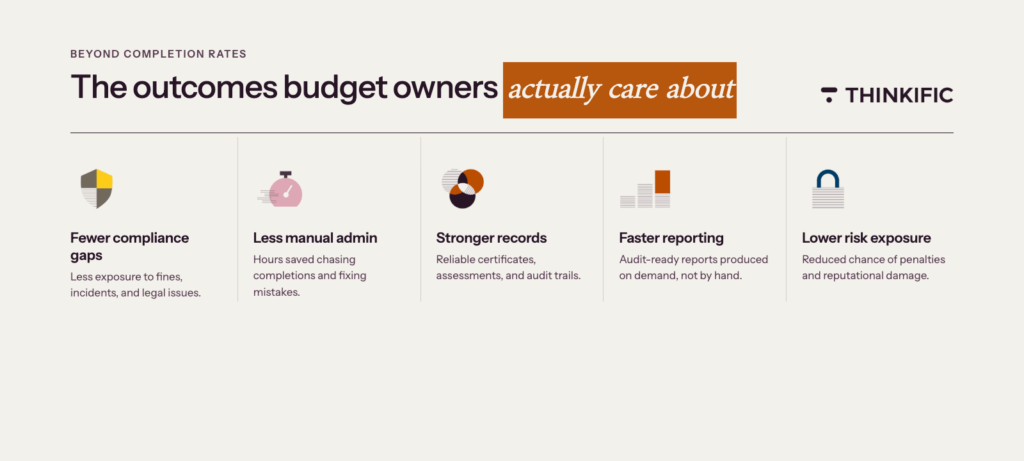
That is where compliance training ROI comes in. It gives you a way to connect the program to the outcomes budget owners actually care about, such as fewer compliance gaps, less manual admin work, stronger records, faster reporting, and lower exposure to fines, incidents, legal issues, or reputational damage.
In this article, we’ll break down why compliance training ROI is hard to measure and four ways to build a stronger case for the value of your compliance program.
Skip ahead:
- What is compliance training ROI?
- Why is it so hard to measure the ROI of your compliance training program?
- Four ways to measure the ROI of your compliance training program
- Make measuring compliance training ROI easier for your organization
- Compliance training ROI FAQs
What is compliance training ROI?
Compliance training ROI (Return on Investment) measures the value an organization gets from the money, time, and effort it invests in compliance training.
This is an important metric because compliance training isn’t cheap. Depending on the size of the organization and the industry’s regulatory requirements, companies can spend anywhere from hundreds of dollars per employee to well into the six figures annually on compliance programs.
Without a clear ROI, it’s much harder to justify that level of investment, especially when budgets get tight. If the only thing your leadership team sees is a six-figure bill and vague claims that the training is “important,” they’ll naturally start questioning whether the program is worth the cost.
Why is it so hard to measure the ROI of your compliance training program?
If the survival of your compliance training program, and future investment in it depends on proving ROI, why do so many L&D and compliance leaders struggle to do it?
1. The business cost of non-compliance isn’t always visible
The impact of compliance training isn’t always quantifiable, save for situations where non-compliance results in a clear financial penalty, such as regulatory fines, legal settlements, or remediation costs.
But many compliance programs aren’t designed to prevent a single measurable event. Take workplace harassment training, for example. The goal isn’t simply to reduce the number of formal complaints. It’s to help employees recognize inappropriate behavior, encourage intervention, and create a safer workplace culture. Even if the training is highly effective, it can be difficult to quantify the value of complaints that were never filed or issues that were resolved before they escalated.
This makes ROI difficult to calculate. The costs of compliance training are easy to see: software licenses, content development, facilitator fees, and employee time spent in training. The benefits, however, are often tied to risks avoided and better decisions made, which makes them much harder to quantify and communicate to leadership.
2. Compliance training software measures learning outcomes
Learning management systems for compliance training typically track metrics such as course completion, learner engagement, and assessment scores. But you cannot use metrics to directly measure the impact of the training program on the business.
Take course completion rate, for example. A 95% completion rate indicates that almost everyone who signed up completed the training. That’s good for judging program success, but it doesn’t immediately show how much that result impacted business outcomes like revenue or cost efficiency. That gap makes it difficult to measure training ROI.
3. No universal frameworks for measuring training ROI
Even if you can overcome the challenges of invisible outcomes and limited LMS data, there’s another problem: there is no universally accepted way to measure compliance training ROI.
Most organizations use some variation of the Kirkpatrick Model, which evaluates training across four levels:
- Reaction: Did employees find the training useful?
- Learning: Did they acquire the intended knowledge or skills?
- Behavior: Did their behavior change after the training?
- Results: Did those behavioral changes improve business outcomes?
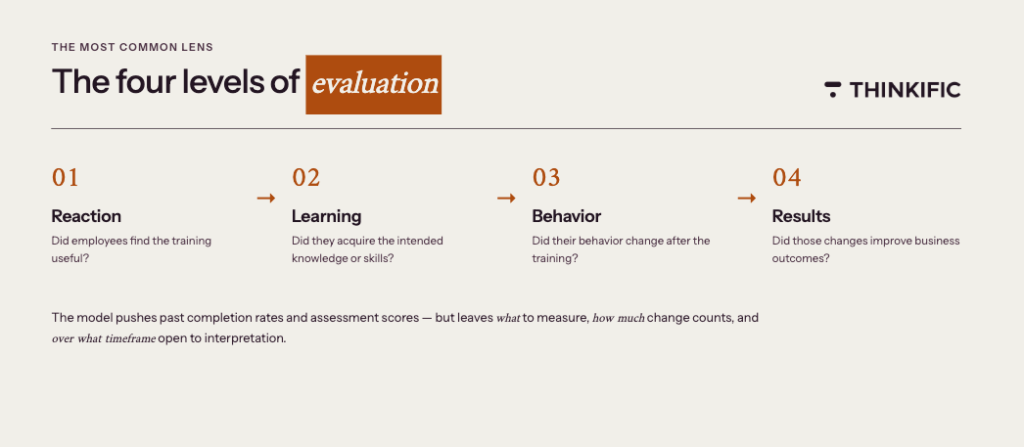
The model is useful because it encourages organizations to look beyond completion rates and assessment scores. However, it leaves a lot of room for interpretation. As Kevin Kruse, founder and CEO of LeadX, puts it, one issue with the Kirkpatrick Model is that “it makes learner reaction the foundation for evaluating training.”
Take behavioral change, for example. What behavior are you measuring? How much change is enough to count as success? And over what timeframe should that change occur: 30 days, 90 days, six months, or a year after training?
The same ambiguity exists at the results level. If a compliance incident occurs after training, does that mean the program failed? If incidents decrease, how much of that improvement can be attributed to training versus other factors such as new policies, management oversight, or process changes?
The Kirkpatrick framework helps organizations think about training effectiveness, but it doesn’t provide a standardized methodology for calculating ROI.
Four ways to measure the ROI of your compliance training program
There’s no universally accepted method for measuring compliance training ROI because every business has different compliance requirements and objectives. So, instead of searching for a perfect ROI formula, focus on identifying the outcomes your organization cares about and finding ways to connect them to your compliance training program.
The following approaches can help you build a more credible case for the value of your training investment.
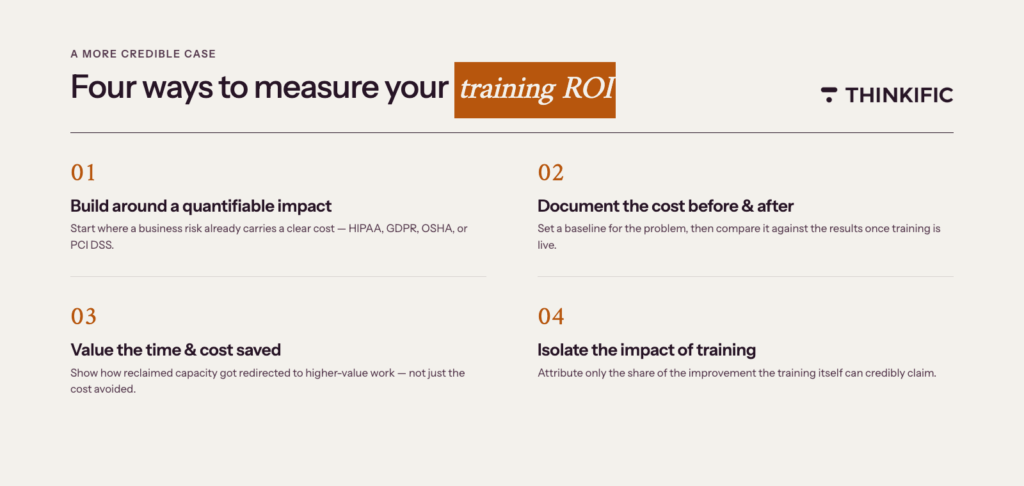
1. Build your compliance program around a quantifiable business impact
The easiest compliance training ROI to measure is one that is tied to a business risk that already has a clear cost.
If your organization must comply with regulations such as HIPAA, GDPR, OSHA, or PCI DSS, start there. Non-compliance in these areas can result in fines, legal costs, remediation expenses, lost business, and reputational damage.
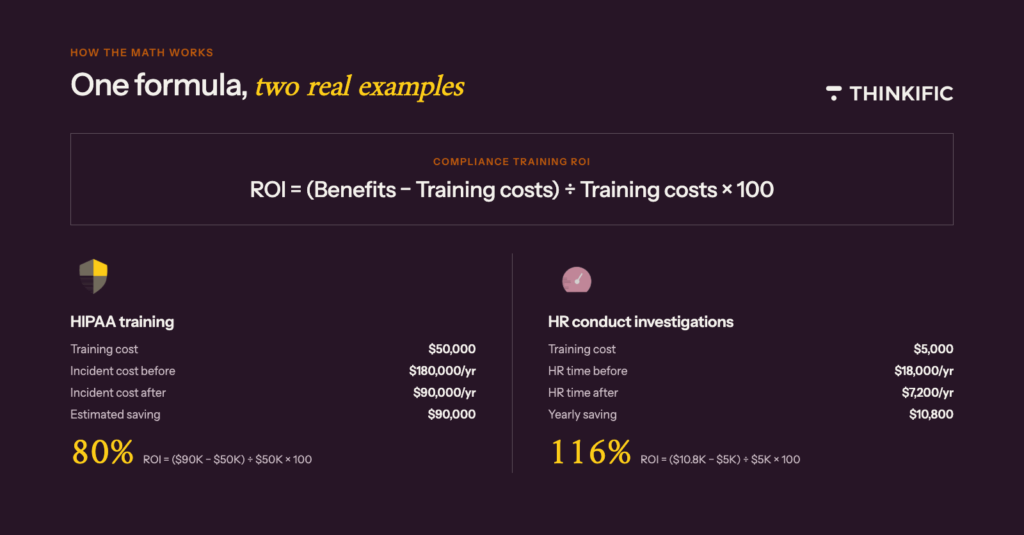
Take HIPAA training as an example. Recent HIPAA penalty guidance puts civil penalties at roughly $145 to $2.19 million per violation, depending on the level of culpability. That gives healthcare organizations a clearer financial risk to measure against.
For example, suppose a healthcare provider spends $50,000 on HIPAA training. Before the training, privacy-related incidents cost the business an estimated $180,000 per year in investigation time, remediation work, legal support, and potential penalties. After the training, those costs drop to $90,000. The estimated saving is $90,000.
Using the compliance training ROI formula: ROI = (Benefits – Training costs) ÷ Training costs × 100
ROI = ($90,000 – $50,000) ÷ $50,000 × 100 = 80%.
The key takeaway is that some compliance topics naturally lend themselves to ROI measurement because the business already understands the cost of getting compliance wrong. If you’re struggling to demonstrate ROI, start with these areas first.
2. Document the cost of the problem before and after training
Not every compliance issue comes with a clear financial penalty.
In these situations, one of the best ways to measure ROI is to establish a baseline before launching your training program and compare it against the results afterward.
Start by documenting the current cost of the problem you’re trying to solve. This could include the time employees spend resolving compliance issues, the number of incidents reported, productivity lost to recurring mistakes, investigation costs, or hours spent by HR, legal, or compliance teams managing preventable issues.
For example, suppose HR spends an average of 20 hours per month investigating workplace conduct issues that stem from employees not understanding company policies. If the fully loaded cost of HR time is $75 per hour, that’s $1,500 per month, or $18,000 per year.
After introducing compliance training, HR’s investigation time falls to 8 hours per month.
The annual cost drops from $18,000 to $7,200, resulting in a yearly savings of $10,800.
If the training program cost $5,000 to develop and deliver, the ROI would be: ROI = (Benefits – Training costs) ÷ Training costs × 100
ROI = ($10,800 – $5,000) ÷ $5,000 × 100 = 116%
This approach won’t give you a perfect ROI calculation. However, it helps translate compliance problems into business costs, making it easier to demonstrate the value of your training program to stakeholders.
3. Calculate the value created from time or cost savings
Time and cost savings are useful starting points for measuring ROI, but they do not always tell the full story.
For example, compliance training may reduce the number of repeat policy questions HR receives, the time managers spend escalating preventable issues, or the cost of correcting compliance mistakes. Those savings matter, but leadership may still ask: What did the business gain from the time or money saved?
This is where L&D teams can strengthen the ROI case by showing how saved resources were redirected.
If HR spends less time resolving recurring compliance issues, that capacity can be directed toward higher-value work such as improving onboarding, resolving employee relations cases faster, or reducing case backlog. If training reduces remediation costs, those savings can be reinvested into stronger controls, better documentation, or audit readiness.
In other words, the ROI is not only the cost avoided. It is also the additional value created because teams had more capacity to focus on work that moves the business forward.
A simple formula could look like this: Extended ROI = (Cost savings + value created from reinvested time or money – training costs) ÷ training costs × 100
This gives L&D leaders a stronger story to tell. Instead of saying, “The training saved us time,” you can show how it freed up resources and helped the business use them more effectively.
4. Isolate the impact of training
One of the biggest challenges with calculating compliance training ROI is proving that the training was actually responsible for the outcome.
For example, imagine your organization launches a cybersecurity compliance training program and phishing incidents fall by 40% over the next six months.
Can you confidently say the training caused the improvement?
Maybe. But it’s also possible that IT introduced stronger email filtering, managers reinforced security best practices, or employees became more cautious after hearing about a high-profile data breach.
This is why the Phillips ROI Methodology emphasizes the importance of isolating the effects of training before calculating ROI. In practice, this means separating the impact of the training program from other factors that may have contributed to the result.
One way to do this is by comparing groups. For example, if one department completed the training before another, you could compare incident rates between the two groups. Another option is to work with managers, compliance leaders, or department heads to estimate how much of the improvement can reasonably be attributed to the training versus other initiatives.
Let’s say workplace conduct complaints decreased by 25% after a new compliance training program. After reviewing the data, HR and compliance leaders determined that approximately 60% of the improvement was likely due to the training, while the remaining 40% was driven by policy changes and increased management oversight.
Instead of claiming the training was responsible for the entire improvement, you would only attribute 60% of the benefit to the training when calculating ROI.
This approach produces a more conservative ROI calculation, but it is often more credible. Rather than claiming training deserves full credit for every positive outcome, it acknowledges the reality that compliance results are usually influenced by multiple factors.
Make measuring compliance training ROI easier for your organization
Compliance training costs show up on every budget spreadsheet. What the program prevents rarely does, because risks avoided and incidents that never happened aren’t visible in reports. The four approaches in this article give L&D and compliance teams a concrete way to close that gap: putting numbers on outcomes leadership already tracks, not just training metrics they don’t.
That’s what a compliance program looks like when the business can see what it’s actually doing.
Put Thinkific Plus behind your compliance training program
Thinkific Plus gives compliance teams the reporting and analytics to connect training activity to the outcomes described in this article. Track learner progress, completion rates, and assessment performance alongside integrations with your HR and compliance systems, so the data you need to build an ROI case is in one place, not pieced together from manual exports.
Start a free trial or book a demo with the Thinkific Plus team.
Compliance training ROI FAQs
Got more questions about tracking the return on investment for compliance training? You’ll find some helpful answers below.
1. How do you make a business case for compliance training?
To make a business case for compliance training, show how training reduces business risk, prevents costly compliance failures, and improves operational efficiency.
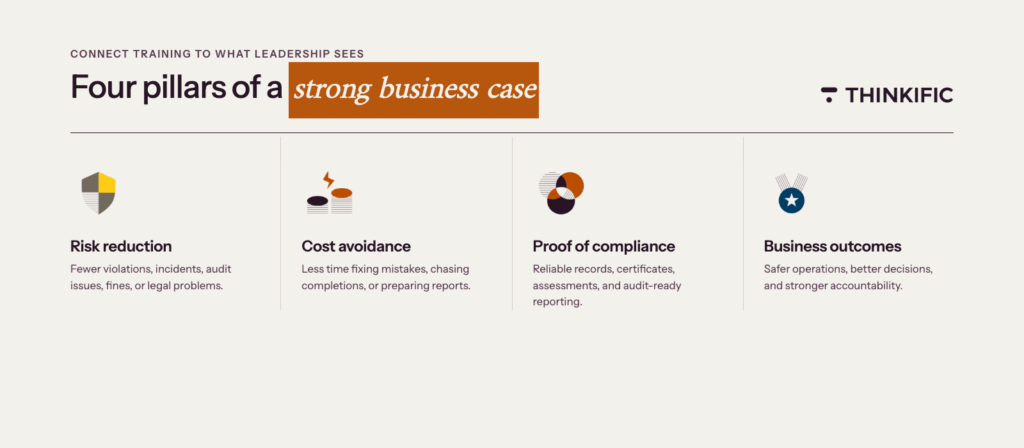
A strong business case should connect training to:
- Risk reduction: Fewer violations, incidents, audit issues, fines, or legal problems.
- Cost avoidance: Less time spent fixing mistakes, chasing completions, or preparing reports manually.
- Proof of compliance: Reliable records, certificates, assessments, and audit-ready reporting.
- Business outcomes: Safer operations, better employee decision-making, and stronger accountability.
2. How do you calculate compliance training ROI?
To calculate compliance training ROI, compare the cost of running the training program with the financial value it creates or protects.
A simple formula is: Compliance training ROI = (Training benefits − Training costs) ÷ Training costs × 100
3. How do you improve compliance training ROI?
Here are solid strategies to improve compliance training ROI:
- Use role-based training: Give people training that matches their actual job, not a generic course for everyone.
- Reuse content: Turn core courses into refreshers, onboarding lessons, job aids, and recertification materials.
- Use a compliance training LMS: Centralize courses, reminders, certificates, records, and reports to make the program easier to manage and prove.