

A compliance manager gets an audit request on Friday afternoon. They need proof that hundreds of learners completed the right training, renewed their credentials on time, and still meet current requirements.
The credentials exist. The challenge is pulling together accurate records quickly enough to respond with confidence.
Most credential programs don’t struggle with issuance. The pressure comes later, when teams need to maintain accurate records, manage renewals, and respond to verification requests at scale.
Credential management software helps organizations issue, verify, renew, and track professional credentials across the full learner lifecycle. Teams commonly use it to manage compliance training, continuing education, certification renewals, and audit-ready learner records.
That same challenge shows up across professional associations, corporate academies, certification programs, and regulated training teams. Someone still has to track expiration dates, send renewal reminders, respond to verification requests, and maintain records that hold up during audits or client reviews.
Those workflows become harder to manage as learning programs expand.
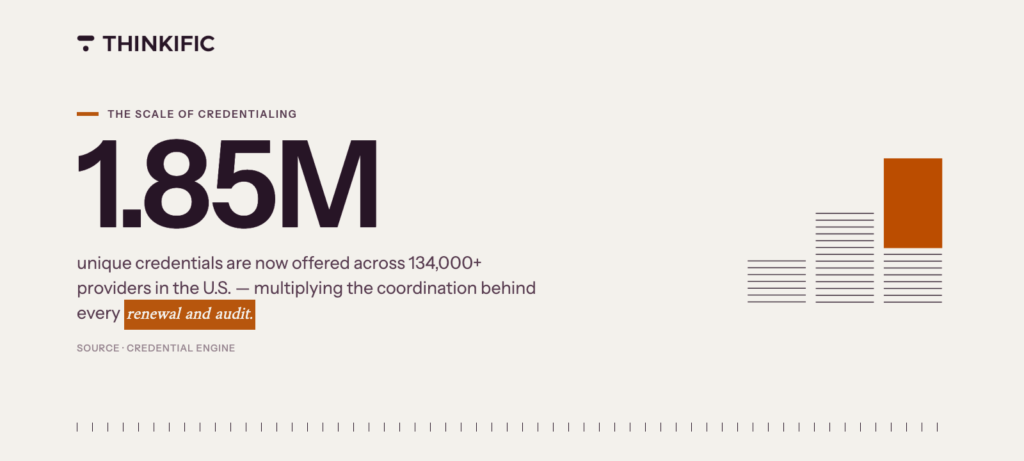
The scale of credential management is growing quickly, too. According to Credential Engine, the United States now has 1.85 million unique credentials offered across more than 134,000 providers. That growth increases the amount of coordination required across credential tracking, verification, reporting, and renewal management.
Larger learner volumes, recurring certification cycles, distributed training programs, and continuing education requirements all increase coordination demands. Compliance expectations continue to rise, too. Learners, employers, regulators, and clients increasingly expect credentials to be current, accessible, and easy to verify.
Spreadsheets and manual tracking processes can support smaller programs for a while. They become difficult to maintain as teams manage hundreds or thousands of records across multiple certification paths.
That’s where credential management software comes in.
This blog post breaks down:
- What credential management software actually does
- The difference between credential management and certificate issuance
- Common challenges teams run into as programs grow
- Features to look for in a credential management platform
- Leading credential management software options for different use cases
If your team already has a credentialing process in place but struggles to maintain it across growing learner groups and certification programs, this article will clarify how dedicated credential management software can improve it. Click on the list above to skip ahead.
What is credential management software?
Credential management software helps organizations manage the full lifecycle of a credential after it’s issued. That includes tracking credential status, verifying learner qualifications, managing renewals, maintaining compliance records, and reporting on credential activity over time.
Many teams already have a process for issuing certificates or certifications. The challenge usually begins later, once credentials need to stay current across hundreds or thousands of learners.
A credentialing team might need to:
- Track expiration dates across multiple programs
- Send renewal reminders automatically
- Validate continuing education requirements
- Respond to verification requests from employers or regulators
- Maintain audit-ready learner records
- Report on active, expired, or overdue credentials
Those workflows often sit across spreadsheets, LMS exports, email threads, and disconnected reporting systems. As credential volumes grow, teams spend more time maintaining records and following up with learners.
Most platforms support workflows across the full credential lifecycle:
Issue → Track → Verify → Renew → Audit
That lifecycle matters in industries where credentials require ongoing oversight instead of one-time completion tracking.
Common examples include:
- Healthcare provider license renewals
- CPR certification programs
- Manufacturing safety training
- Corporate cybersecurity certifications
- Accounting continuing education requirements
- Financial services compliance training
The category also overlaps with certification management, continuing education tracking, and compliance management. Some tools focus heavily on credential verification and regulatory workflows, while others combine credential management with broader learning program delivery.
That distinction matters when evaluating software options. A basic certificate tool may help issue proof of completion, but credential management software supports the ongoing work required to maintain credentials over time.
Credential management vs certificate issuance
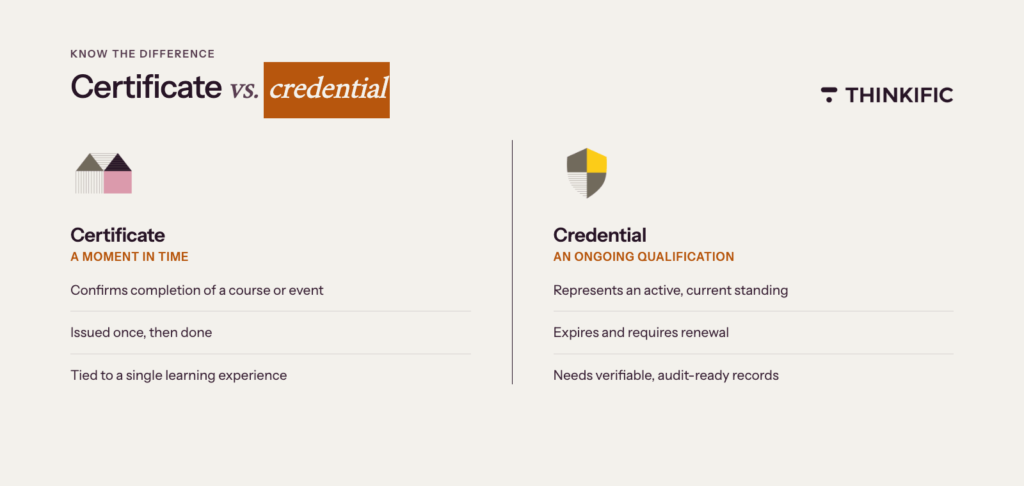
People often use “certificate” and “credential” interchangeably, but they represent different parts of a learning and compliance process.
A certificate usually confirms that someone completed a course, workshop, or training event. It’s tied to a specific learning experience and often issued once at the end of the program.
For example:
- A new employee completes onboarding training and receives a completion certificate
- A learner finishes a CPR course and downloads proof of participation
- A customer completes a cybersecurity awareness module during onboarding
In many cases, certificate delivery is relatively straightforward. A learner completes the required training, and the system automatically or manually generates proof of completion.
Teams building certificate workflows often start with completion-tracking and delivery tools similar to the process outlined in How to Make a Certificate in 8 Steps.
Credentials involve more ongoing management.
A credential often represents an active qualification, certification status, or professional standing that may expire, require renewal, or depend on continuing education. Teams need a way to track whether that credential remains current over time.
Examples include:
- Annual workplace safety certifications
- Healthcare licenses tied to continuing education requirements
- Financial services compliance credentials
- Manufacturing training certifications that require periodic renewal
Ongoing credential management creates additional operational requirements.
Credential management software commonly supports:
- Renewal tracking
- Verification requests
- Continuing education management
- Credential status reporting
- Audit-ready recordkeeping
- Expiration notifications
Verification also becomes more important once credentials affect compliance, hiring, licensing, or customer trust. A training completion certificate may only need to confirm participation. A professional credential often requires a verifiable record that shows the credential holder still meets current requirements.
This distinction matters when evaluating platforms. Some systems focus primarily on issuing certificates after training completion. Others support the ongoing lifecycle management required for regulated learning programs and professional credentialing, which overlaps closely with broader certification management software workflows.
Why manual credential tracking breaks down
Many credentialing teams start with manual systems because they work well enough early on.
A spreadsheet tracks expiration dates, renewal reminders go out through email, and learner records live across shared drives, LMS exports, or internal databases. Someone on the team handles verification requests when they come in.
That process can support a smaller credential program without creating major operational issues.
Complexity usually grows gradually as learner volumes, certification paths, and reporting requirements expand.
A corporate academy managing hundreds of annual renewals may need to track multiple certification timelines across departments. A professional association might oversee several certification paths with different continuing education requirements. Training teams operating across regions often manage learner records across separate systems and reporting structures.
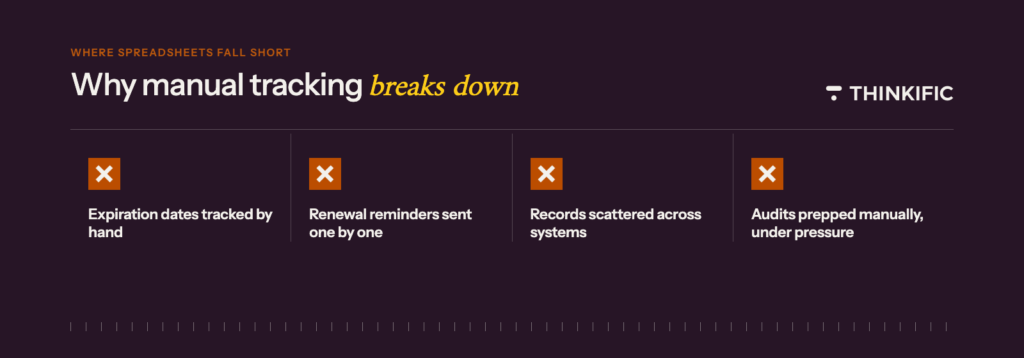
Common friction points start to appear:
- Expiration dates tracked manually across spreadsheets
- Renewal reminders sent individually
- Learner records spread across disconnected systems
- Verification requests handled one at a time
- Audit preparation requiring manual reporting work
- Limited visibility into expired or overdue credentials
- Learners struggling to access proof of certification quickly
None of these issues necessarily point to a broken process. Manual systems simply become harder to sustain as credential programs grow.
A missed renewal reminder may leave credentials inactive longer than expected. Audit requests can pull credentialing teams away from other priorities for days at a time. Compliance managers may not have a reliable view of credential status across the organization. Learners often feel that friction too when they need quick access to proof of completion or active certification status.
Administrative work also increases as programs expand into continuing education, recurring certifications, or multi-program learning paths. Teams spend more time maintaining records and less time improving the learning experience itself.
Credential management software helps reduce that burden by centralizing records, automating renewal workflows, and providing clearer visibility into credential status across programs.
The credential lifecycle: issuance, verification, and renewal
Credential management software supports much more than credential delivery. Most teams need a way to manage credential activity long after a learner completes training.
That lifecycle usually includes issuing credentials, validating credential status, managing renewals, and maintaining records for compliance or reporting purposes.
Issuing credentials at scale
Automated credential issuance helps teams manage large learner volumes without relying on manual processing.
Issuing credentials manually may work for smaller programs with limited learner groups. Larger training organizations and corporate academies often need a more structured process tied directly to learner progress and completion requirements.
Most platforms support automated credential issuance after learners complete required training or certification milestones. Teams can define eligibility rules tied to assessment scores, attendance requirements, course completion, or continuing education thresholds.
That reduces administrative follow-up and creates a more consistent learner experience.
For example, a healthcare training provider may automatically issue a CPR certification after learners complete required coursework and pass a final assessment. A corporate academy might issue onboarding certifications once employees finish compliance training and policy reviews.
Many platforms also support branded digital credentials that learners can access, download, or share directly. That visibility matters for customer certification programs, professional training organizations, and internal workforce development initiatives.
Teams managing multiple learning products often connect credential issuance directly to learner progress tracking and automated completion workflows. Training groups can issue credentials across courses, certification pathways, or cohort-based programs without relying on manual processing.
This approach works especially well for:
- Compliance training programs
- Customer education academies
- Employee onboarding certifications
- Partner enablement programs
- Continuing education initiatives
Credential workflows tend to run more smoothly when they connect directly to the learning experience rather than operate separately from it.
Verifying credentials quickly and reliably
Credential verification tools help teams confirm credential status quickly without relying on manual record checks.
Verification workflows become more important once certifications affect compliance status, vendor eligibility, licensing, or customer trust.
Many teams still manage verification requests manually through email or internal record reviews. That process creates unnecessary administrative work, especially for credentialing teams handling large learner volumes.
Public verification links, searchable learner records, and centralized verification portals help reduce that workload.
Learners can often access credentials directly through self-service portals, while employers, clients, or regulators can validate credential status through centralized databases or public verification links.
Verification workflows commonly support:
- Vendor qualification reviews
- Workforce compliance audits
- Customer certification validation
- Licensing checks
- Internal HR reporting
Audit preparation also becomes easier when credential records are stored in a single system. Compliance managers can review active, expired, or overdue credentials without pulling data from multiple spreadsheets or disconnected reporting tools.
Recurring certification programs require searchable learner records and centralized credential history to simplify audits and verification requests. Teams also gain clearer visibility into learner activity without having to validate records manually.
Managing renewals and continuing education
Renewal management becomes more complex once credentials expire or require ongoing continuing education.
Training teams may need to monitor annual recertifications, track continuing education credits, notify learners about upcoming expiration dates, and maintain records for compliance verification. Those workflows become difficult to coordinate manually across large learner groups.
Most credential management platforms support renewal tracking tied to credential expiration dates, continuing education completion, or recertification milestones. Learners can receive automated reminders before credentials lapse, while compliance managers maintain visibility into credential status across programs.
This is especially common in:
- Annual compliance certification programs
- Multi-year professional credential programs
- Regulated workforce training
- Healthcare continuing education
- Financial services certification management
Some teams also build recertification pathways directly into their learning programs. A learner nearing credential expiration may automatically receive access to refresher training, updated coursework, or continuing education modules tied to renewal requirements.
Clear credential visibility helps teams manage compliance reporting and audit reviews with less manual follow-up.
Features to look for in credential management software
Credential management platforms vary widely in the support they offer. Some focus primarily on issuing digital certificates, while others handle renewal workflows, compliance tracking, verification, and long-term learner record management.
The right fit depends on how your team manages credentials today and how much operational complexity you expect to support over time.
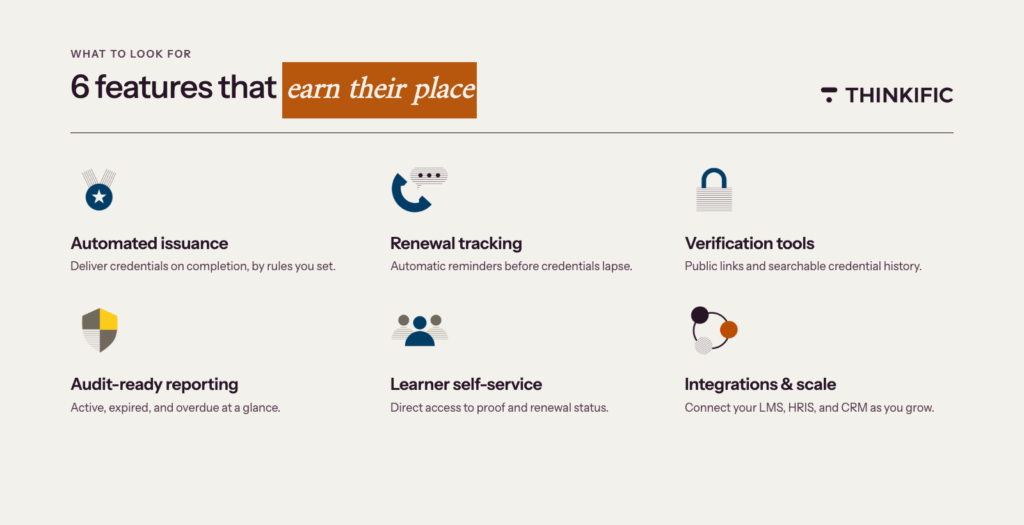
Automated credential issuance
Most credential management platforms support trigger-based issuance tied to learner activity. A credential can be issued automatically after a learner completes required coursework, passes an assessment, attends a training session, or meets continuing education requirements.
Useful capabilities include:
- Automated credential delivery after course completion
- Custom completion rules and learner eligibility requirements
- Branded digital credentials
- Learner progress tracking tied to credential issuance
- Group-based credential delivery for team training programs
Renewal tracking and reminders
Renewal management often creates the largest ongoing administrative burden.
A platform should help teams track expiration dates, monitor credential status, and automate reminders before credentials lapse. Manual renewal tracking becomes harder to maintain as certification timelines and continuing education requirements expand.
Helpful functionality includes:
- Expiration notifications for learners and administrators
- Automated renewal reminder workflows
- Continuing education tracking
- Recertification pathways
- Credential status reporting across learner groups
These workflows are especially important for recurring compliance certifications and continuing education programs.
Credential verification tools
Verification workflows should reduce administrative work for both learners and credentialing teams.
Public verification links, searchable learner records, and centralized verification portals help teams respond to compliance checks, vendor reviews, and audit requests more quickly. Instead of manually validating credentials via email or internal spreadsheets, administrators can access credential records from a single system.
Helpful capabilities include:
- Public credential verification links
- Searchable credential history
- Secure learner records
- Verification portals for employers or regulators
Audit-ready reporting
Reporting requirements often expand as credential programs grow.
Compliance managers, auditors, HR teams, and external partners may all need visibility into credential activity, learner completion records, or renewal status. Pulling that information manually across spreadsheets and disconnected systems takes time and increases the likelihood of incomplete reporting.
Strong reporting capabilities include:
- Centralized learner and credential records
- Exportable reports
- Historical credential activity
- Compliance visibility across programs
- Reporting filters for active, expired, or overdue credentials
Clear reporting workflows reduce administrative overhead during audits and internal reviews.
Learner self-service access
Learners increasingly expect direct access to their credentials, renewal timelines, and certification history.
Self-service portals reduce administrative requests while giving learners a clearer view of their credential status. This is especially helpful for continuing education programs, workforce certifications, and customer academies managing large learner groups.
Common features include:
- Credential download access
- Renewal status visibility
- Continuing education records
- Credential sharing options
Integrations and scalability
Credential workflows rarely operate in isolation.
Many teams need credential data connected to learning platforms, HR systems, CRM tools, reporting software, or internal compliance workflows. Integration needs usually grow alongside credential programs.
Look for platforms that support:
- LMS integrations
- HRIS integrations
- CRM compatibility
- Team permissions and administrator roles
- Multi-program credential management
- Shared learner records across departments
Scalability matters once credential programs expand across teams, departments, or certification tracks. A platform that works well for a single certification program may become difficult to manage when multiple credentialing teams and learning programs are involved.
Best credential management software platforms
Credential management platforms approach the category from different angles. Some focus heavily on compliance verification and digital credential delivery, while others combine credential workflows with broader learning program management, learner engagement, and continuing education delivery.
The right choice depends on how your team manages credentials today, the level of complexity you need to support, and whether credentialing closely aligns with broader learning programs.
One quick note before diving in: Thinkific is included in this list because it supports certification programs, learner management, and scalable academy experiences. Some platforms specialize more heavily in standalone credential verification or badge management.
Credential management software comparison table
| Platform | Best for | Key strengths | Credential lifecycle support | Considerations |
| Thinkific | Organizations combining credential management with scalable learning programs | Learning products, learner engagement, automation workflows, communities, coaching, and Webinars | Issuance, learner tracking, renewal support through learning workflows, reporting | Better suited for learning-driven credential programs than standalone regulatory registries |
| Accredible | Digital credential issuance and badge management | Digital credentials, badge sharing, credential verification | Issuance, verification, credential sharing | Less focused on broader learning delivery |
| LearnUpon | Corporate learning and compliance training | Employee training management, compliance tracking, and reporting | Issuance, renewal workflows, reporting | Primarily built for internal workforce training |
| TalentLMS | Internal employee certification programs | Lightweight LMS functionality, certification tracking | Certification issuance, expiration tracking | May require additional tools for advanced credential workflows |
| Canvas Credentials (Badgr) | Portable credentials and digital badges | Open badges, learner-owned credentials, badge portability | Issuance, sharing, verification | Badge-focused approach may not fit all compliance workflows |
| Certifier | Credential issuance and verification workflows | Digital certificates, verification links, branded credentials | Issuance, verification, credential access | More credential-focused than full learning management |
| Sertifier | Professional certification and verification management | Credential automation, digital badges, reporting | Issuance, verification, reporting | Learning delivery capabilities may require integrations |
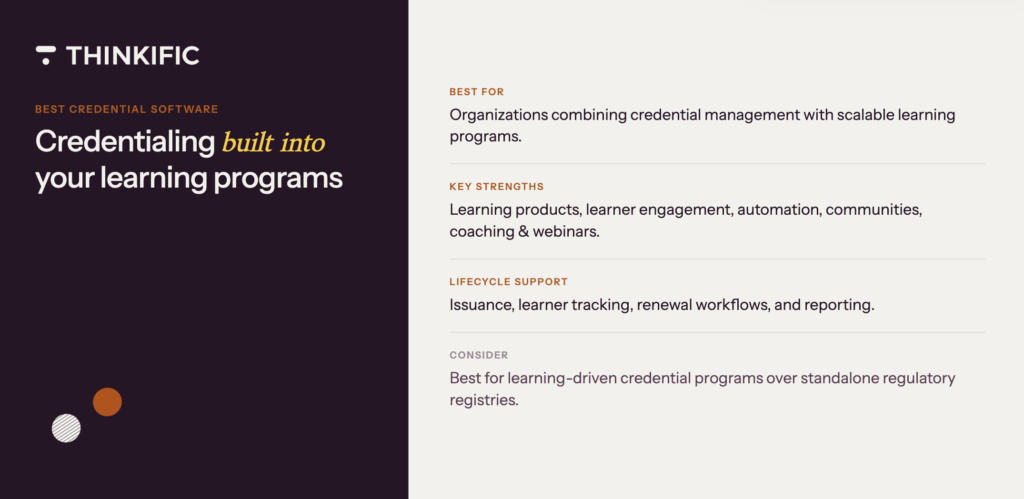
Thinkific works well for teams that want credential management connected to scalable learning delivery, learner engagement, and continuing education programs.
Many credential programs involve more than just credential issuance. Teams often need one platform for training delivery, learner progress tracking, certification pathways, learner communication, and ongoing education programs.
Thinkific supports those workflows with:
- Digital learning products
- Certification programs
- Learner progress tracking
- Automated completion workflows
- Communities
- Coaching and Webinars
- Flexible academy experiences
- Integrations with business and learning tools
This makes Thinkific a strong fit for:
- Customer education academies
- Partner certification programs
- Continuing education programs
- Corporate training teams
- Professional learning organizations
Organizations managing highly specialized regulatory credential databases may still require additional tooling.
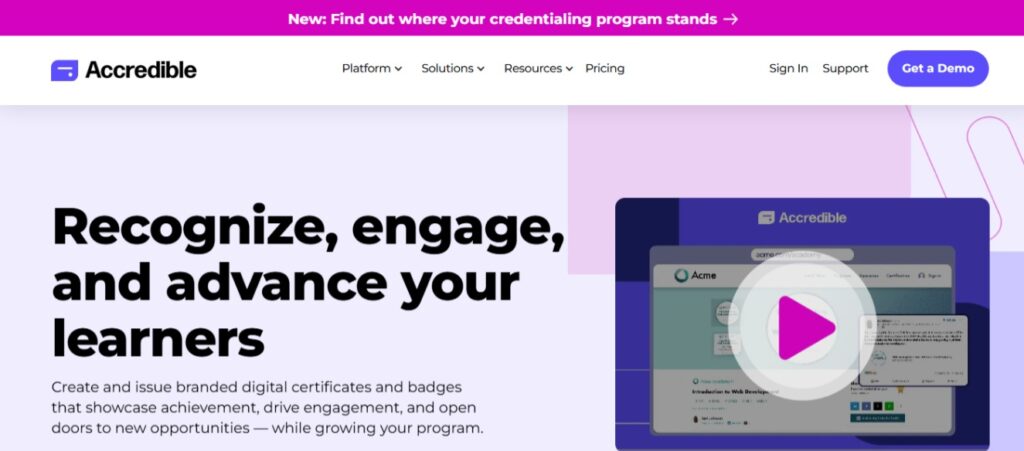
Accredible focuses heavily on digital credential issuance, badge management, and credential verification.
Certification organizations and training providers often use Accredible to issue branded digital credentials and enable public verification workflows. Verification workflows and credential portability are major strengths.
Teams looking for a dedicated credential infrastructure layer often pair Accredible with an LMS or broader learning platform.

LearnUpon is geared toward corporate learning, employee development, and compliance-focused training programs.
The platform includes certification tracking, reporting, learner management, and recurring training workflows. Many teams use LearnUpon to centralize employee compliance and workforce training operations.
It’s generally best suited for internal training environments rather than external customer academies or public certification ecosystems.
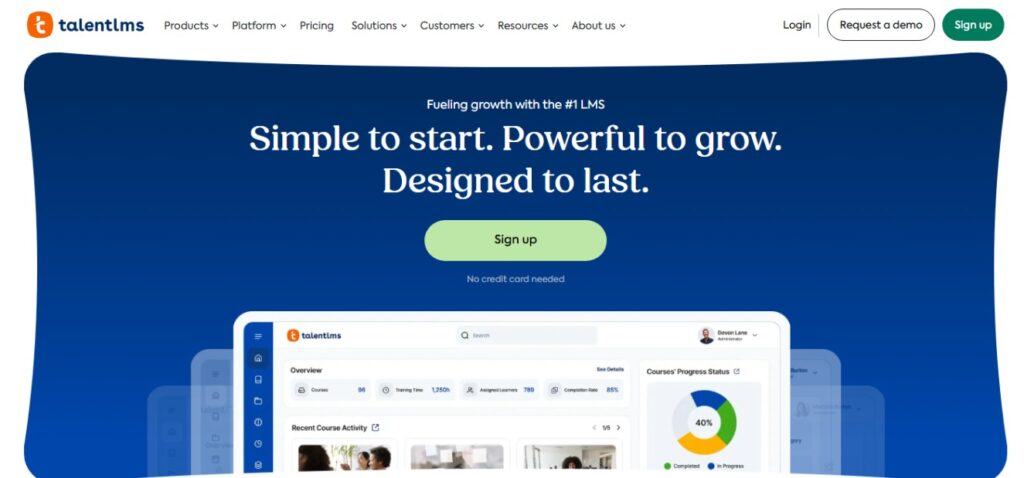
TalentLMS offers certification management capabilities within a lightweight learning management platform.
Training teams commonly use it for employee onboarding, internal certifications, and recurring workforce education. Expiration tracking and certification reporting are available without requiring a large enterprise implementation.
Teams with more advanced compliance verification or credential portability requirements may eventually outgrow simpler certification workflows.
Canvas Credentials (Badgr) centers heavily on digital badges and portable credentials.
The platform supports open badge standards, credential sharing, and learner-owned credential records. Educational institutions, workforce development programs, and organizations prioritizing portable digital credentials often explore this approach.
Badge-focused systems can work well for recognition and skill validation programs, though some regulated industries may require broader compliance management workflows.
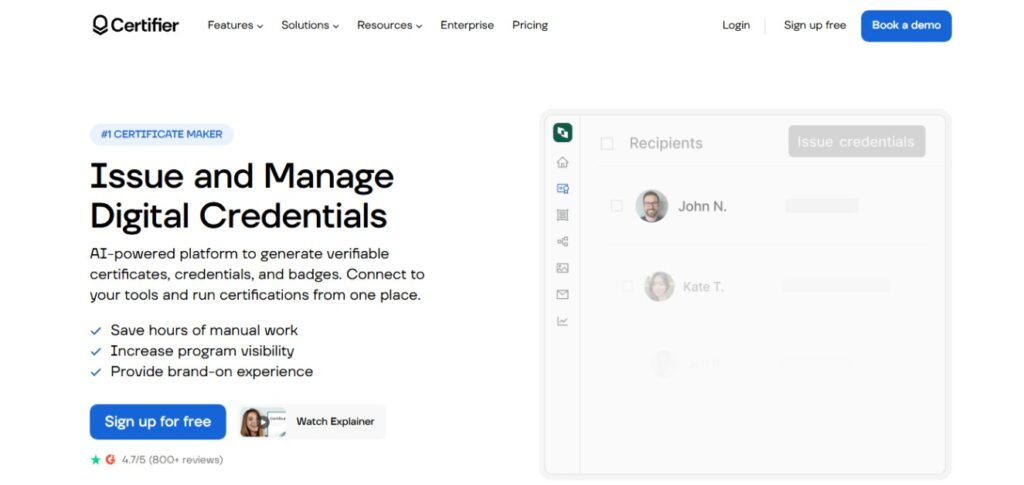
Certifier focuses on digital certificate issuance, credential verification, and related workflows.
Teams can generate branded digital credentials, provide verification links, and automate certificate delivery after training completion. Many organizations use Certifier alongside broader learning systems rather than as a full learning management environment.
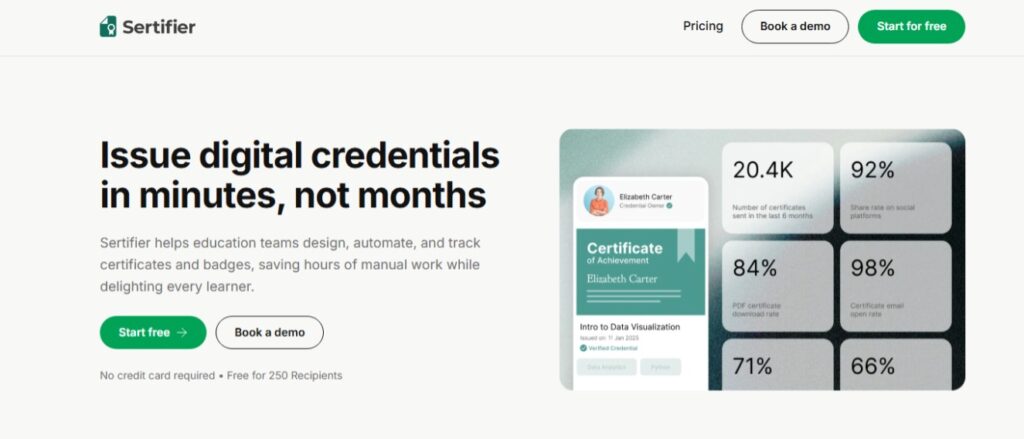
Sertifier combines credential issuance, verification, digital badges, and reporting tools within a credential-focused platform.
Teams managing professional certifications or training credentials often use Sertifier for automated certificate delivery and verification workflows. The platform also supports analytics tied to credential activity and learner engagement.
Organizations running larger learning ecosystems may still require separate platforms for course delivery, learner communities, or continuing education program management.
How to choose the right credential management software
The best credential management platform depends heavily on how your organization delivers training, manages compliance requirements, and supports learners over time.
Some teams primarily need credential issuance and verification. Others manage recurring certification cycles, continuing education programs, or large-scale training operations that involve multiple departments and stakeholder groups.
A platform that works well for one use case may create limitations in another.
Start with the operational side of the process first. Platform features matter, but day-to-day workflows usually reveal what your team actually needs.
Questions worth asking early in the evaluation process include:
- How many credentials does the organization issue each year?
- Do credentials expire or require recurring renewal?
- Are continuing education credits part of the certification process?
- How frequently do auditors, employers, or clients request credential verification?
- Do learners need direct access to credentials and renewal status?
- Will the platform support broader learning programs or only credential tracking?
- How many internal teams need visibility into learner and credential records?
Those answers usually narrow the field quickly.
For example, a professional association managing multiple certification pathways may prioritize continuing education tracking, audit-ready reporting, and verification workflows. A corporate academy supporting employee onboarding may prioritize learner engagement, automation, and integrations with HR systems.
Learning delivery often becomes part of the decision, too.
Some credential management platforms focus heavily on verification infrastructure and digital credentials. Others support credential workflows within broader learning environments that include courses, cohort programs, learner communication, and ongoing education pathways.
Teams planning for long-term growth often benefit from platforms that support both credential management and scalable learning delivery within a single system.
When a learning platform becomes part of credential management
Credential management often expands into broader learning operations over time.
Most teams eventually need a way to connect credentials with the broader learning experience. That usually includes delivering training, tracking learner progress, communicating with learners, managing recertification pathways, and supporting ongoing education programs.
Teams often start with a single certification program, then expand into continuing education, customer training, or recurring compliance workflows. Healthcare training organizations often deliver continuing education content alongside renewal tracking, while corporate academies may manage onboarding certifications, annual compliance training, and customer education programs from the same environment. Professional associations frequently support learning libraries, member communities, and recurring certification pathways together.
That’s where learning platforms become part of the credential management conversation.
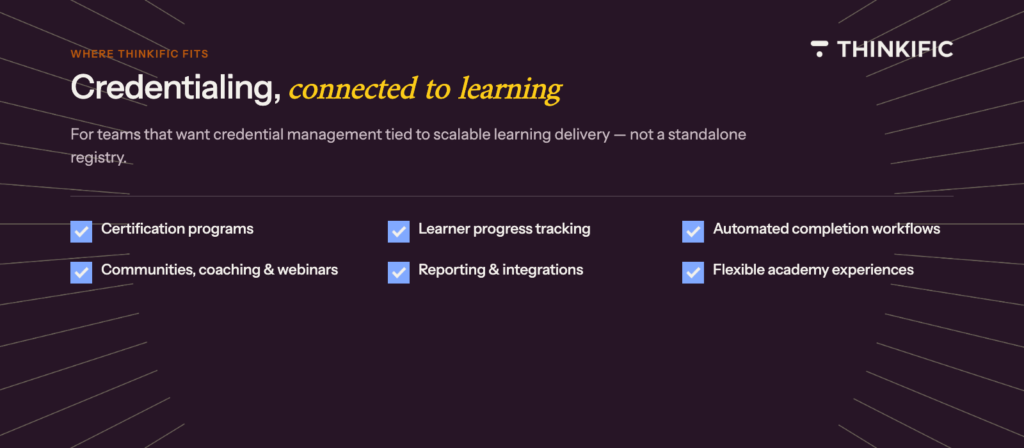
Platforms like Thinkific combine credential-related workflows with scalable learning delivery and learner engagement tools. Teams can build learning products, manage certification programs, support cohort-based learning, automate learner communication, and create branded academy experiences from one platform.
Capabilities like:
- Communities
- Cohort programs
- Email Automation
- Reporting and integrations
- Learner progress tracking
- Flexible academy management
help connect credentialing workflows to the broader learner experience instead of managing them separately.
This becomes especially valuable for continuing education programs, customer academies, partner certification initiatives, workforce compliance training, and professional development programs. Teams managing regulated learning programs often need systems that support credential maintenance alongside recurring compliance training and continuing education workflows.
For teams researching how credential management connects to compliance-focused training operations, Thinkific’s guides to compliance training software and the ROI of compliance training provide additional examples of how learning delivery, reporting, and certification workflows increasingly operate together.
Reducing complexity across the credential lifecycle
Credential management becomes more demanding as learning programs grow.
What starts as a manageable process for issuing certificates can evolve into renewal tracking, compliance reporting, continuing education management, and credential verification across multiple learner groups. Many teams eventually reach a point where spreadsheets, manual reminders, and disconnected reporting workflows create unnecessary administrative work.
The right credential management software helps teams centralize learner records, automate recurring workflows, and maintain clearer visibility into credential status across programs. Learners also benefit from easier access to credentials, renewal information, and continuing education pathways.
Many teams eventually need training delivery, learner communication, and certification workflows connected in the same environment. Connecting those workflows can simplify ongoing program management for credentialing teams, compliance managers, and learners alike.
If your organization is evaluating credential management platforms, start by identifying the operational challenges your team faces most often today. Renewal workflows, verification requests, learner communication, and reporting requirements usually reveal the biggest process gaps.
From there, look for a platform that supports both current credential operations and future growth of the learning program.
Managing renewals, verification requests, and learner records at scale requires more than a basic platform.
Thinkific Plus gives compliance teams, corporate academies, and continuing education programs the infrastructure to deliver training, automate certification workflows, and maintain audit-ready learner records across large and distributed learner groups, with dedicated support built in.
If your credentialing program is growing beyond what your current tools can handle, talk to our team about what Thinkific Plus can support.