
Solutions
|
Enterprise LMS
The enterprise LMS built for fast launches and measurable business growth
Tired of your legacy enterprise LMS taking months to launch, while still leaving gaps in engagement and reporting? Thinkific launches faster, with onboarding, compliance, and skills development unified on one platform.

The skills gap is growing faster than most training programs can keep up
The skills gap is costing businesses billions of dollars (and growing) every year, creating growing gaps in performance, productivity, and readiness. Using a slow or clunky LMS adds to this, leaving your workplace and business exposed.
According to the World Economic Forum, the skills gap costs the global economy an estimated $8.5 trillion annually, with the majority of companies reporting current or anticipated skills shortages.
Companies with strong learning cultures see 57% higher retention rates compared to those with weaker learning cultures. Source: LinkedIn Workplace Learning Report.
Enterprise LMS, defined: More than just a course library
An enterprise LMS (learning management system) is a centralized platform that manages onboarding, compliance training, and skills development across large or distributed workplaces. Enterprise LMSs like Thinkific connect learning to business systems and workflows, track progress at scale, and give administrators more control so they can run learning and training programs across multiple teams, regions, and roles.
While a course library works great for small teams with simpler needs, an enterprise LMS gives you the control, flexibility, and infrastructure to run learning at scale, with tools and features like single sign-on, deep reporting and analytics, multi-language support, multi-site management, and custom roles and permissions.
| Standard LMS | Enterprise LMS – Thinkific | |
|---|---|---|
| User scale and access control | Hundreds of learners, basic admin roles | Thousands, across regions and roles, specific role-based permissioning, SSO, and custom user groups |
| Brand and multi-site management | Basic branding in one learning environment | Fully branded experiences across multiple sites, audiences, and programs managed centrally |
| Compliance and reporting | Completion tracking | Audit-ready reports, certification management, and advanced analytics |
| Integrations | Limited third-party connections | CRM, SSO, and API access |
| Rollout support | Self-serve setup | Dedicated onboarding, implementation support, and a customer success team |
Onboarding, compliance, and certification: What an enterprise LMS needs to handle
Thinkific is the one platform built to manage enterprise business needs like onboarding, compliance, and certification that keep your learners and partners performing.
Structured customer and employee onboarding
Get your learners up and running faster and more effectively with Thinkific’s tools designed for streamlined onboarding for both customers and employees. Build guided learning paths that walk learners through what they need to know quickly, automate enrollment to make sure nobody slips through the cracks, and drip content to ensure they retain information and avoid overwhelm.
86% of people say they’d be more likely to stay loyal to a business that invests in onboarding content that welcomes and educates them after they’ve bought.
Source: Wyzowl Customer Onboarding Statistics

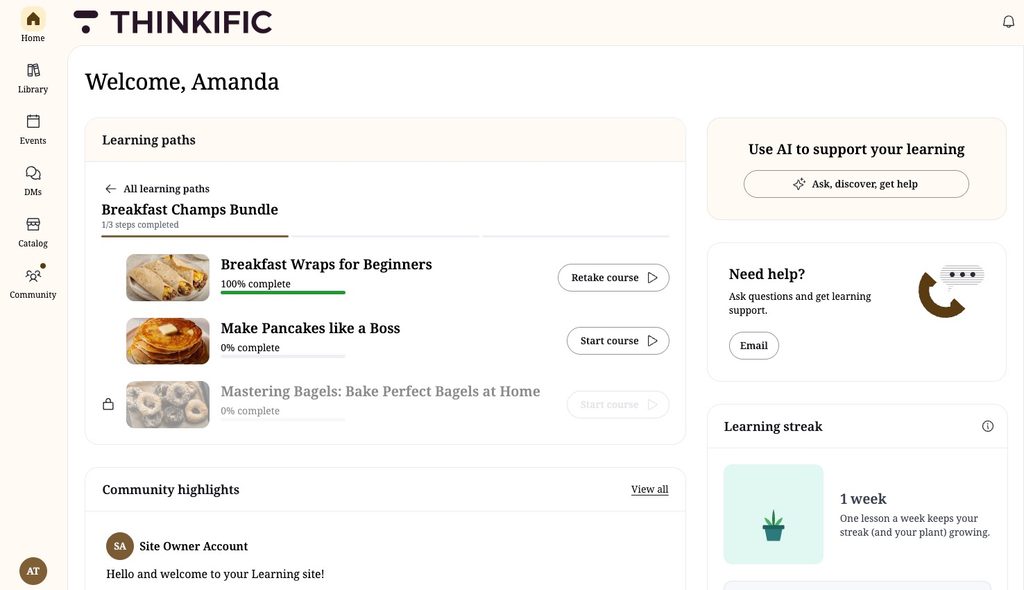
Compliance and regulatory training
Protect your business from risk with Thinkific’s infrastructure built to deliver, track, and report on compliance programs at scale, without having to stitch together separate systems. With support for SCORM imports, automated completion reminders, and reporting that helps you stay audit-ready, Thinkific’s enterprise LMS provides your team with the tools to build and manage an iron-clad compliance and regulatory program.
A study from the Ponemon Institute and Globalscape found that the average cost for organizations that fail to comply with data protection regulations is $14.82 million, with non-compliance costing 2.71 times the cost of maintaining or meeting compliance requirements.
Learner certification programs and partner enablement
Whether providing certification programs for individual learners or partner enablement, these structured offerings help customers get more value from your content. Thinkific gives you everything you need to build structured certification programs, modular content libraries, and role-specific learning paths that scale across your customer base and partner network. As certifications can be shared on LinkedIn and other professional networks, every credential your learners earn extends your brand reach, turning your training program into an acquisition channel.
Gusto’s data science team estimated certified partners bring in 40% more clients in the 90-day post-certification window.
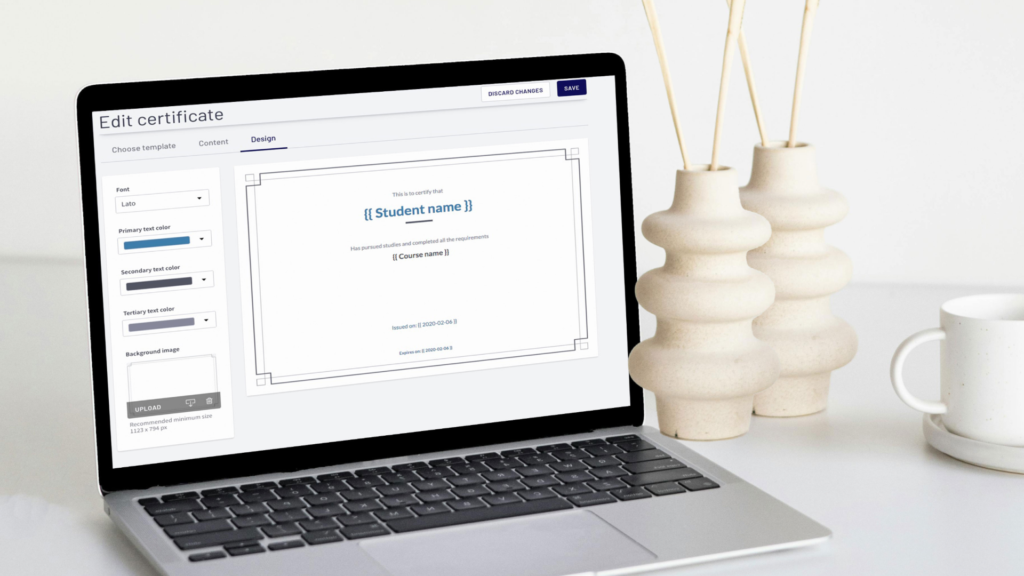
Core capabilities of a modern enterprise LMS
From white-labeled experiences to an AI teaching assistant, Thinkific’s enterprise LMS includes the ability to do more, all in one place.
White-label, branded academies
A custom domain, logo, colors, and CSS mean your learners see your brand, not Thinkific’s.
Multi-site management
Run separate learning environments and Group Experiences for each audience you train, all managed from one central login.
SCORM
Import interactive content from any authoring tool, then track completions, pass rates, and scores with analytics tools.
CRM integrations
Native Salesforce and HubSpot integrations sync enrollment, progress, and completion data straight to your customer records.
Enterprise SSO
Connect Okta, Auth0, JumpCloud, Active Directory, AWS Cognito and other OpenID Connect identity providers so external learners sign in with their existing credentials.
Thinker: Thinkific’s AI teaching assistant
Learners get instant answers from Thinker, an AI assistant trained on your content, cutting down on manual support load as you scale.
The numbers behind enterprise learning programs
What structured training returns, measured by third parties.
229%
Training ROI
Average return across revenue, operational efficiency, and customer satisfaction.
86%
Retention
Customers stay more loyal to businesses that invest in onboarding after they sign up or purchase.
42%
Sales enablement
More likely to improve win rates on a unified enterprise LMS and enablement platform.
75%
Faster time to launch
Less onboarding time at PayShepherd. 350 hours saved in three months.
What external training on Thinkific looks like in practice
These organizations built scalable external training programs on Thinkific.
The results speak for themselves
We don’t ask you to take our word for it, we let the data do the talking. Our awards are fuelled by 400+ real-world reviews, making Thinkific one of the highest-rated learning platforms on G2.

Enterprise teams running
on Thinkific
These organizations built high-performing training programs on Thinkific’s enterprise LMS.
Carrick Institute successfully transitioned its extensive curriculum of 385 courses and 4,400+ hours of content to Thinkific. After struggling with an unstable WordPress-based tech stack, the Institute rebuilt its platform using an API-first architecture to improve reliability and learner engagement.
Z-Health simplified a complex, 11-step certification sales process into a single purchasing decision, driving a 30–40% increase in course completion rates across 16,000+ health and movement professionals worldwide.
GTM Partners turned their Wall Street Journal bestselling go-to-market framework into a scalable online academy, generating over $500,000 in revenue in under a year and certifying 40+ professionals to build their own advisory businesses on top of the GTM Partners brand.
From kickoff to go-live: The rollout timeline
Most enterprise LMS rollouts don’t fail at launch, they fail in the months of setup, hours of expensive training, and back-and-forth that come before. Here’s how Thinkific keeps that from happening.
1
Scoping call
Your customer success manager starts by mapping your learning goals, use case, learner base, and technical requirements so the build and launch of your learning program has a clear foundation from day one.
2
Build and migrate with your launch specialist
Your dedicated launch specialist guides you through course setup, integrations, and any content migration, so nothing gets left behind.
3
Launch and measure
Go live with analytics in place from the start, so you can track learner progress, completion rates, and business outcomes right away.
Join the other Thinkific customers who launch in an average of 64 days.
Frequently asked questions
What is an enterprise LMS?
An enterprise LMS is a centralized platform for delivering, tracking, and reporting on learning and training programs. Unlike basic LMS tools built for smaller teams, enterprise platforms are designed to handle complex user structures, multiple use cases, and large learner volumes — with the administrative controls and integrations to match.
What features should an enterprise LMS include?
The core features to look for are SSO, SCORM support, learning paths, role-based permissions, robust reporting, white-labeling, multi-tenant and multi-language support. Depending on your business needs, the features you require can shift — compliance programs demand audit-ready reporting, while customer onboarding and skills development place more weight on learner experience and completion tracking.
How is an enterprise LMS different from an LXP?
An enterprise LMS delivers structured, trackable, and compliance-driven training, with defined paths and completion requirements. An LXP is self-directed, surfacing content through recommendations rather than assignments. Some platforms, including Thinkific, support both structured programs and self-directed learning from a single system, removing the need to manage two separate tools.
Can an enterprise LMS handle compliance training?
Yes. Enterprise LMS platforms like Thinkific support compliance training through certifications, completion tracking, automated reminders, and reporting dashboards, along with other features and tools.
How long does it take to implement an enterprise LMS?
Thinkific customers launch in a median of 64 days. Other enterprise LMS platforms commonly take several months to implement due to heavy configuration requirements and limited onboarding support. With a dedicated launch specialist and a well-scoped implementation process, Thinkific offers a significant difference in time to go-live.
Does an enterprise LMS integrate with HR systems?
Yes. Enterprise LMS platforms typically integrate with HRIS and CRM systems to sync enrollment, completion, and learner data automatically. Integration depth varies, where some platforms offer real-time sync while others rely on batch imports.