

You’ve t’ve thought of the perfect way to train employees or customers on a new concept or skill, and now you need to create a winning training proposal to convince key stakeholders that your training solution is the best choice for their needs.
Since they won’t have the same level of understanding about the topic as you do, it’s crucial to communicate your ideas effectively while making a sound business case.
In this article, you’ll learn how to write a training proposal using Thinkific’s specially designed template, which you can tweak to fit any situation.
Skip ahead:
- What is a Training Proposal?
- The 5 steps to creating an effective training proposal
- Training proposal template (for corporate and employee training)
- Adapting the Training Proposal Template for Different Contexts
- Which Digital Tools Can You Use to Create Training Proposals?
- Frequently Asked Questions
What is a training proposal?
A training proposal is a document that outlines a plan to deliver a training program to a specific audience. It explains what will be taught, why it matters, how it will be delivered, and what results are expected, usually to get approval, budget, or buy-in from stakeholders.
For example, let’s say you notice that new hires make a ton of mistakes in their first week and take too long to ramp up. You might come up with an onboarding training program designed to:
- Standardize how new hires learn key processes and tools
- Reduce common errors early on
- Shorten time-to-productivity
- Improve overall performance and confidence
But just having what you believe is a solid plan doesn’t mean your higher-ups will sign off on it.
For that to happen, you need to present a detailed proposal that clearly shows what the training will involve, and, more importantly, the ROI for the organization.

Get the Training Proposal Template
Create compelling proposals that resonate with clients and elevate employee training.
What are the types of training proposals?
At a high level, training proposals can be grouped into two main types:
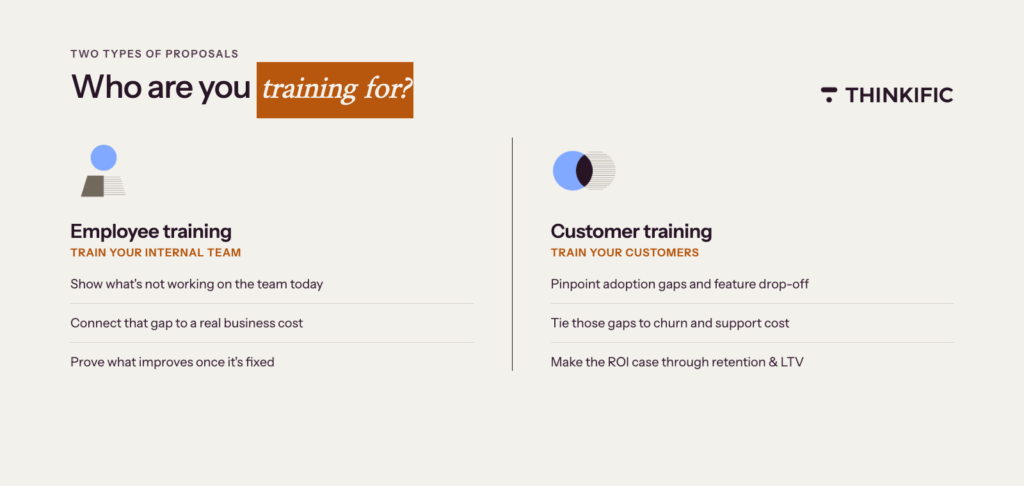
- Employee training proposal
This is a proposal you write to get approval for training your internal team. You’re essentially saying: “Here’s a gap in how our team is performing, and here’s a training program that fixes it.” That could mean onboarding new hires, leveling up specific skills, or training people on new tools and processes.
To succeed, a good employee training proposal needs to:
- Clearly show what’s not working right now
- Explain why that’s actually a problem for the business
- Connect the dots between the issue and the training you’re proposing
- Spell out what will improve if this gets implemented
- And make it obvious that it’s worth the time and investment
- Customer training proposal
This is a proposal you write to get approval for training your customers or clients. To succeed, a strong customer training proposal needs to:
- Clearly identify where customers are underutilizing the product or struggling (adoption gaps, feature drop-off, misuse)
- Tie those gaps to business impact (increased support costs, churn risk, lower product stickiness)
- Position training as a lever to improve activation, engagement, and retention
- Define expected outcomes (higher feature adoption, reduced support tickets, improved customer satisfaction)
- And make a clear ROI case through increased customer lifetime value (LTV), improved retention rates, and more efficient support operations
The 5 steps to creating an effective training proposal
Here’s how to write a training proposal that quickly secures executive buy-in and approval.
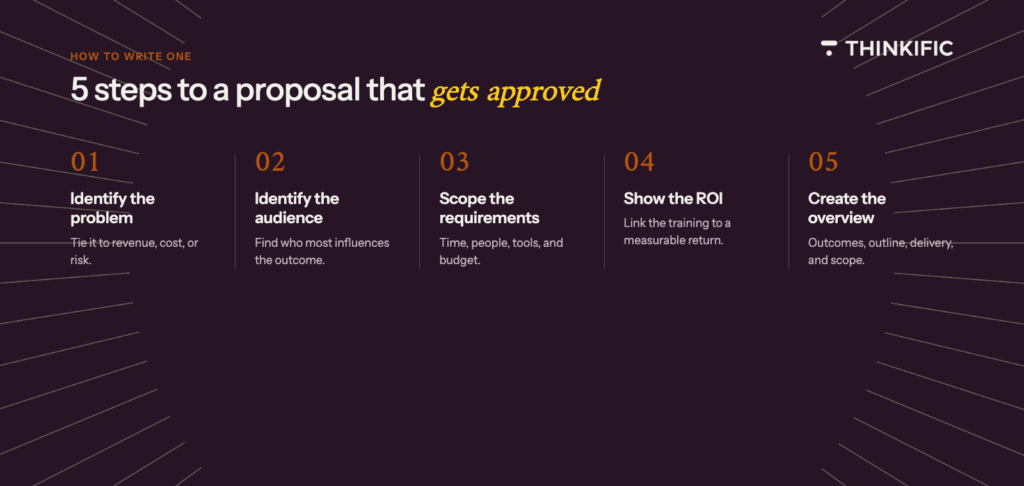
- Identify the business problem
Tying your training proposal to a business problem turns it from a nice-to-have idea to an important business decision that impacts revenue, performance, efficiency, or risk. This makes it easier to get executive buy-in and approval.
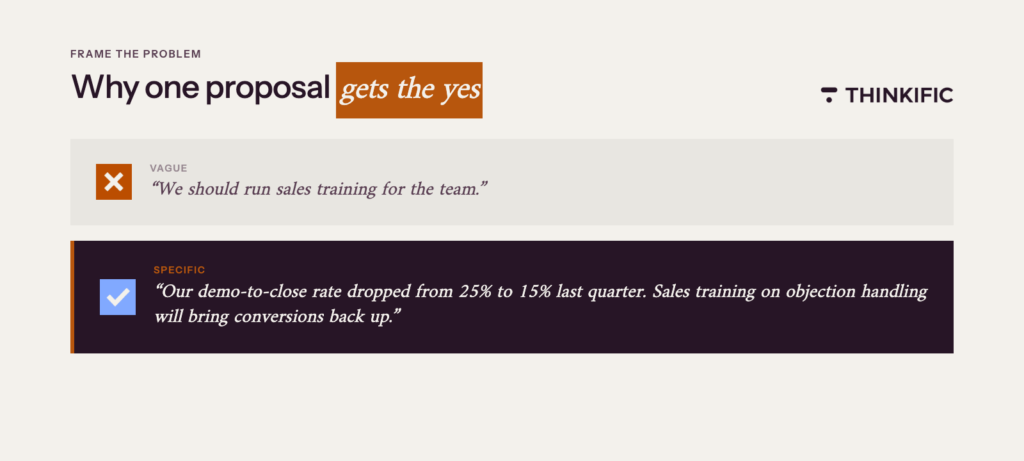
Let’s say two proposals land on your desk:
- Proposal 1: “We should run sales training for the team.”
- Proposal 2: Our demo-to-close rate has dropped from 25% to 15% over the last quarter, which is impacting revenue. We should run sales training to improve objection handling and bring conversion rates back up.”
The second is more likely to be approved than the first because it contextualizes the problem, explains how the training will fix it, and ties the outcome to a result the business cares about.
Most business problems fall into two categories:
- Cost leaks: That is, situations where the business is losing money due to inefficiencies, such as high error rates, rework, support escalations, churn, etc.
- Revenue gaps: That is, situations preventing the business from scaling revenue or profit, such as low conversion rates, missed targets, slow ramp time, and poor upselling/cross-selling.
Next, trace the problem back to a skill gap. Not every problem is a training problem. Your job is to ask: Is this happening because people don’t know how to do something? For example:
- Low sales: Is it due to poor lead quality or weak objection handling? The former isn’t something you can fix with sales training.
- High support tickets: Is it a product issue or due to a lack of product knowledge? If it’s the latter, then it makes sense to organize a training session.
Finally, talk to the people closest to the problem to get actual context and validate the problem.
It’s easy to look at the numbers, come up with a theory for why something is happening, and jump straight into designing a solution. But without input from the people dealing with the issue day to day, you risk solving the wrong problem or building a redundant solution.
For example, you might see that sales conversion rates are dropping and assume the team needs objection-handling training. But when you speak to the team, you realize the bigger issue is unclear pricing or an overwhelming team workload, not necessarily a skill gap. In that case, training won’t fix the problem.
- Identify the target audience
Knowing your target audience will help you to scope the training content and format effectively. Without it, you might end up including information your audience already knows or doesn’t need, or including people who cannot implement the desired action after the training.
For example, if you’re proposing product training, it’s easy to say it should be for the entire go-to-market team — sales, support, marketing, and customer success. And while that sounds logical, each of those teams will interact with the product differently. If you try to train all of them in one go, the content either becomes too shallow to be useful or too detailed to be relevant for everyone.
Instead:
i. Identify the group of people who directly affect the outcome you’re trying to achieve or influence with the training. For example, let’s say you notice that deals are taking much longer to close. Your immediate instinct might be to train the sales team.
But when you dig deeper, you might notice that sales is actually moving quickly; it’s procurement and legal reviews that are stalling. In that situation, training salespeople won’t fix the problem. Your job is to trace the outcome back to specific behaviors, then identify which group has the most direct influence over changing them.
ii. Decide where the highest leverage is. Not every problem should be solved at the level where it appears. For example, if ten reps are struggling with the same objection, you could train all ten of them. Or you could train their manager to coach it — and fix it for every rep they’ll ever manage, including ones who haven’t joined yet. Find the audience for which the training could have the desired outcome at scale.
- Scope the training requirements
Scope the training requirements in your proposal so stakeholders know exactly what resources, time, and support are needed, and can plan, allocate, and approve them upfront.
When scoping training requirements, think of everything that needs to be in place to make the training successful. This includes:
- Time commitment: How much time participants need to attend and complete the training, and how that fits into their existing workload.
- Audience availability: Whether the right people can realistically participate (scheduling, time zones, workload conflicts).
- Trainers or facilitators: Who will deliver the training — internal managers, external experts, or a dedicated trainer?
- Content and materials: What needs to be created or prepared (slides, playbooks, exercises, case studies) to support the training delivery?
- Tools and platforms: Any systems required to deliver the training (LMS, video tools, product environments, sandbox accounts).
- Budget: Costs for trainers, tools, content development, or external vendors.
- Manager support: Whether managers are aligned and will reinforce the training (e.g., follow-ups, coaching, accountability).
- Operational impact: How the training affects day-to-day work (reduced capacity, coverage plans, deadlines).
For example, you might discover that key participants will not be available for the training on your proposed date. That could influence your training delivery method, for example, from live classes to self-paced learning.
- Show the expected training ROI
Spelling out the expected ROI helps you justify the investment.
Training isn’t cheap. It requires time, budget, and pulls people away from their day-to-day work. So to get buy-in, you need to show what the business gets in return.
That means clearly linking the training to measurable outcomes such as increased revenue, reduced costs, improved efficiency, or lower risk, and making it obvious why the investment is worth it.
Use this formula to calculate your estimated training ROI:
Estimated ROI = [(Estimated financial benefit – total training cost) ÷ Total training cost] × 100
For example, let’s say you organize sales training for 10 SDRs. Right now:
- Each SDR takes 3 months to ramp
- Once ramped, each SDR generates $15,000/month in pipeline
- You estimate that training will reduce ramp time by 1 month.
Step 1: Calculate the financial benefit
If each SDR becomes productive 1 month earlier, that’s: $15,000 × 10 SDRs = $150,000 in additional pipeline
Step 2: Calculate the training cost.
Let’s say the training program costs $20,000. This amount includes LMS subscription fees, employee time, and related costs.
Step 3: Apply the ROI formula
ROI = [(Benefit − Cost) ÷ Cost] × 100
That is: ($150,000 − $20,000) ÷ $20,000 × 100 = 650% ROI.
This means, for every $1 spent on training, the business gets $6.50 back in value. In your proposal, you can say: “This training is expected to reduce SDR ramp time by one month, generating approximately $150,000 in additional pipeline. With a training cost of $20,000, this represents a ~6.5x return.”
- Create your training overview
A training overview is a high-level summary of what the training will look like , enough for stakeholders to understand what they’re approving, without getting into execution-level detail.
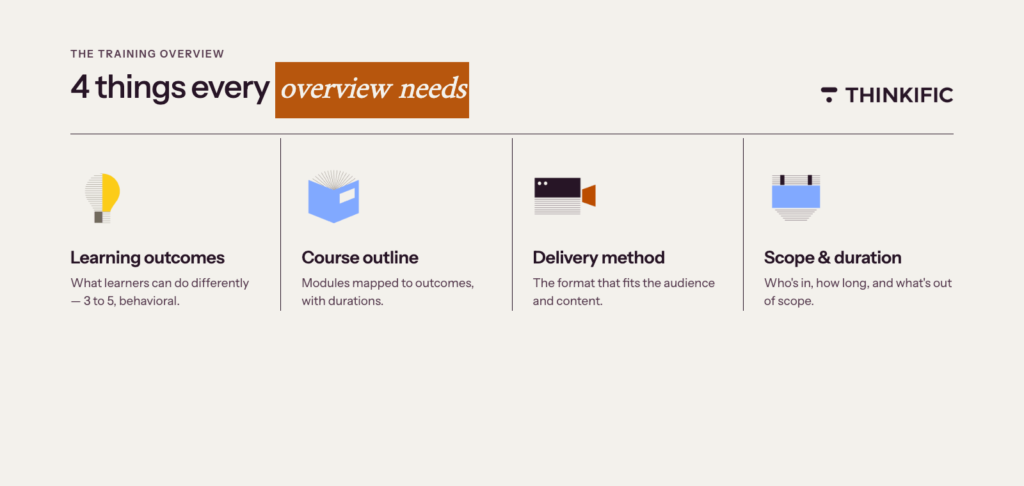
It includes:
a. Learning outcomes
Learning outcomes tell stakeholders what participants will be able to do differently after the training. Keep them specific and behavioral. For example: At the end of this training, sales reps will be able to confidently resolve tier-one complaints without escalating, using the company’s four-step resolution process.
Aim for three to five outcomes per training. Any more and the scope is probably too broad.
b. Course outline
The course outline shows the structure of the training at a high level — that is, the modules or sessions it includes, not individual slides or activities. Stakeholders don’t need to see every lesson; they need to see that the content is logical, maps to a clear outcome, and adds up to the expected ROI.
For each module, include:
- The topic
- The learning outcome it maps to
- Approximate duration
c. Delivery method
Specify how the training will be delivered and why that format fits the audience and content.
Common training delivery methods include instructor-led (in-person or virtual), self-paced e-learning, blended, or on-the-job coaching. The right choice depends on your audience size, geographic spread, complexity of the content, and budget.
For example, if you’re delivering training to new customers, a self-paced or blended format works best because it allows them to learn at their own pace, revisit key concepts as needed, and onboard without being blocked by scheduling.
This is also the place to include any supporting tools or systems, such as a learning management system (LMS). If you’re using one, briefly explain how it will support the training, for example:
- Hosting and organizing content
- Tracking participation and completion
- Standardizing the learning experience across participants
This helps stakeholders understand not just how the training will be delivered, but how it will be managed and scaled.
d. Scope and duration
Scope defines who is included and what is covered. Duration is how long the training will take — per session, in total, and over what timeframe.
Be explicit about what’s out of scope, too. If the training covers new hires but not existing staff, say so. If it covers the sales process but not the CRM tool, say so. This protects you later and helps stakeholders set the right expectations.
When complete, this section should read something like:
“This training will be delivered as a two-day instructor-led workshop for 24 customer success managers across the APAC region, with supporting materials hosted on Thinkific for participants to reference after the program.
By the end of the training, participants will be able to manage escalations independently, identify at-risk accounts early, and apply the company’s retention playbook in live customer scenarios. The program is structured across six modules and will run over two consecutive days, with a follow-up coaching session four weeks later.”
Training proposal template (for corporate and employee training)
If everything we’ve outlined above feels overwhelming, that’s because it can be. Creating a training proposal means thinking through the business problem, defining outcomes, scoping requirements, and proving ROI, all in a way that gets executive buy-in. It’s a lot of work, especially when you’re doing it for the first time.
To make it easier for you to get started, we’ve created a comprehensive, adaptable template you can use for both corporate and employee training. Inside, you’ll find customizable training proposal templates for sales, customer support, and so much more, designed to:
- Clearly articulate the business case
- Structure your proposal in a way that stakeholders can quickly evaluate
- Highlight the impact, not just the activity
Use it as a starting point, and tailor it to your organization, audience, and goals.
Get the Training Proposal Template
Create compelling proposals that resonate with clients and elevate employee training.
Adapting the Training Proposal Template for different contexts
There is no one-size-fits-all approach to training, as each audience may have different learning preferences and requirements. You may need a variety of methods.
- Instructor-led training (ILT): Facilitated by a professional trainer or subject matter expert, ILT provides personalized instruction and feedback.
- E-learning: Online courses and modules offer flexibility and convenience for learners, often allowing them to progress at their own pace.
- Blended learning: Combining elements of both ILT and e-learning, blended learning offers a comprehensive approach that caters to various learning styles.
- Workshop-based training: Interactive, hands-on workshops enable participants to practice new skills and collaborate with peers in a group setting.
- On-the-job training: Real-world experiences and guidance from experienced colleagues can be invaluable for skill development and practical knowledge. As you develop your training proposal, consider incorporating a mix of training types to keep things fresh.
The organization can also have diverse priorities and training needs, which may require a tailored approach in your proposal. Here are a few ways to adapt the training proposal for different contexts:
- Target specific skills: Identify the precise skills or competencies to be addressed by the training, and design the program accordingly. For instance, if the focus is on improving communication skills, create a training program that concentrates on active listening, conflict resolution, and non-verbal communication.
- Consider industry-specific requirements: Be mindful of regulations, standards, or industry best practices unique to the organization’s field. Adapt the training proposal template to meet these requirements and demonstrate your awareness of industry-specific context.
- Align with organizational culture: Tailor the training proposal to reflect the organization’s values, attitudes, and work environment. Incorporate language, examples, and scenarios that resonate with the company’s culture and goals.
- Address all levels of expertise: Depending on the target audience, consider whether the training’s content should accommodate varying levels of experience or proficiency. Create a modular structure that allows learners to engage with content based on their background and needs.
- Include post-training support: Sometimes, training can’t be considered a one-time event — additional support is needed for the newly acquired skills to fully integrate into the organization. Mention follow-up or refresher sessions, mentorship programs, or access to further resources as part of your proposal.
Which digital tools can you use to create training proposals?
Using digital tools can greatly enhance the process of creating high-quality, professional training proposals. Integrating these tools into your workflow can save time, improve collaboration, and result in a more polished, engaging final product.
Here are some digital tools commonly used for proposal creation.
| Category | Tools | Use Cases |
| Document and Proposal Writing Tools | Google Docs / Microsoft Word / Apple Pages | Built-in templates for proposalsEasy to edit, collaborate, and export as PDFs |
| Notion | Great for structuring proposals and embedding resources | |
| PandaDoc / Proposify | Pre-built proposal templatesReusable content blocks E-signatures and tracking | |
| Presentation and Visual Design Tools | Canva | Drag-and-drop proposal decksVisual storytelling + charts |
| PowerPoint/Google Slides | Standard for stakeholder presentations | |
| Adobe InDesign | More polished, branded proposal documents | |
| Collaboration and Planning Tools | Trello / Asana / ClickUp | Manage proposal tasks and deadlines |
| Miro / FigJam | Brainstorm training structure and flow | |
| Slack / Teams | Stakeholder feedback loops | |
| Learning Management Systems (LMS) | Thinkific | Deliver training programsTrack learner progressProvide analytics and reporting |
| Multimedia and Content Creation Tools | Powtoon / Camtasia | Video-based training |
| Colossyan (AI video) | Turn scripts into training videos | |
| Loom | Quick walkthrough demos | |
| Learner engagement | Thinkific | Interactive lessons and SCORM-compliant contentLearner communitiesAI teaching assistant Mobile learning support |
| Mentimeter | Live pollsWord clouds and open-ended questions Interactive quizzes |
Elevate employee and customer training with Thinkific
Elevating your employee and customer training starts with the right platform, and Thinkific delivers exactly that.
Whether you’re onboarding new hires, upskilling your workforce, or educating customers on your products, Thinkific empowers you to build engaging, scalable learning experiences that drive real results. With intuitive course creation tools, powerful analytics, and a seamless learner experience, you can transform the way your organization learns and grows.
Don’t let outdated training methods hold your team back.
Start your free Thinkific trial today and build the training program your people deserve.
Frequently Asked Questions
Need to create a training proposal? You’ll find some helpful answers and resources below.
- What is the purpose of a training proposal?
The purpose of a training proposal is to secure buy-in from stakeholders, plus resources and approvals for successful training implementation.
- Who should be involved in the process of creating a training proposal?
Trainers, subject matter experts, instructional designers, project managers, and relevant stakeholders should be actively involved in creating a training proposal. This ensures a comprehensive proposal that meets the target audience’s unique needs and aligns with organizational objectives.
- How can I ensure my training proposal is well-received by decision-makers?
To achieve decision-maker buy-in:
- Articulate objectives, benefits, and ROI
- Research organizational needs and tailor the proposal
- Use clear, concise language
- Leverage data, case studies, or testimonials
- Collaborate with key stakeholders throughout the process
- What are the most common mistakes to avoid when writing a training proposal?
Some of the most common mistakes are insufficient research, overemphasis on methodology, unclear or confusing language, or incomplete and poorly structured proposals.
- How can I present a compelling case for the return on investment of a training proposal?
Present a compelling case by demonstrating tangible and intangible benefits, such as improved employee performance, enhanced satisfaction or engagement, achievement of organizational objectives, and improved customer satisfaction. Support your claims with examples or data.
- What are the components of a winning training proposal?
A training proposal should include an executive summary, a needs analysis, clearly defined learning objectives, a detailed training program outline, and a description of engagement strategies that show how learners will actively participate. It should also cover delivery methods (such as virtual, in-person, or blended learning), a clear timeline and logistics plan, and a measurement framework outlining how success will be evaluated through assessments or business outcomes.
Get the Training Proposal Template
Create compelling proposals that resonate with clients and elevate employee training.