
When customers don’t adopt a product fully, companies absorb the cost in ways that don’t always show up on a single line in the budget: more support tickets, longer onboarding cycles, higher churn, and a customer success team stretched thin managing issues that systemized training would have prevented.
Customer training is how companies close that gap. A well-run customer education program reduces support volume, accelerates product adoption, and keeps customers engaged long after initial onboarding. The question most learning teams face isn’t whether training works — it’s how to measure what it returns and where to invest to get more of it.
This article breaks down how to calculate customer training ROI, what drives it, and how companies are building training programs that pay for themselves.
Click below to skip ahead:
- Understanding customer training ROI
- Benefits of customer training
- Calculating customer training ROI
- Strategies to maximize customer training ROI
- Case study: Flashpoint scales customer education to 3,000+ users
- What strong customer training ROI looks like in practice
- Frequently asked questions
Understanding customer training ROI (return on investment)
Customer training ROI measures the financial return on what your organization spends to educate customers: content creation, platform costs, team time, and delivery, against what that training generates in measurable business outcomes.
But ROI goes deeper than a completion dashboard. The real value of tracking it is in the connection between training and what happens after it: whether customers are adopting the product faster, renewing at higher rates, expanding their usage, and placing fewer support calls. That link: from learning activity to customer success outcomes, is where training programs prove their worth to the business.
According to Thinkific’s 2026 Industry Benchmarks Report, 98% of organizations say education directly impacts sales, support, or revenue. Yet fewer than 1 in 3 can confidently quantify that impact. The gap isn’t in the results: it’s in the measurement infrastructure needed to trace the line from training activity to customer success metrics.
Companies that measure training ROI can make sharper decisions about where to invest more, what to cut, and how to build an internal case for expanding the program.
Tracking ROI also answers the operational questions that matter most to teams engaging in customer training:
- Are customers completing training?
- Is the training content helping customers achieve outcomes?
- Is customer training influencing customer behavior and customer success metrics?
Answers to those questions, grounded in data, are what make it clear that a customer education program is not a cost center, but a growth driver.
Benefits of customer training
Customer training is not a supplement to your product, it’s part of the customer experience.
When customers understand what your product can do and how they can use it to achieve their goals well, the downstream effects touch every part of the business.
Here are just some of the benefits:
- Enhanced customer engagement
Customers who understand a product use it more. Customer training gives learners the context to explore features beyond the basics, progress in skillset, ask more informed questions, and engage with your team in ways that move beyond troubleshooting.
The difference shows up in behavior and expansion: trained customers use your product more regularly, complete more of your product’s workflow, submit more actionable feedback, and come back for repeat purchases or extended contract cycles.
That’s active customer engagement, not just usage data.
- Improved product adoption
When customers know how to use a product, they use it more.
Effective training shortens time to value, reduces the volume of repetitive customer support requests, and increases the likelihood that your customers will discover features they’d otherwise overlook.
The downstream effect is a lighter load on your support or customer success team and a customer base that’s more self-sufficient, reducing your operating costs while improving the customer experience.
- Increased customer retention
Churn is rarely just about a product failing your customers outright. More often, it’s about customers not getting enough value from your product to justify staying. Customer training addresses that issue directly: when someone clearly understands what a product can do for them specifically, they’re more invested in making it work.
Training turns product capability into realized value, and that’s what keeps customers around.
- Up-selling and cross-selling opportunities
Customers who are confident in their core workflow are better positioned to explore what else your product can do. They understand their own use case well enough to see where an additional feature or tier would help them.
This makes expansion, upselling and cross-selling a natural conversation rather than a cold pitch. Your customer success and sales team is working with customers who already know the product and have a reason to expand, not convincing cold leads starting from zero.
Calculating customer training ROI
To understand the effectiveness of a customer training program, you need to measure its ROI: the financial benefits generated from training against the investment made. This formula can give your team a clear picture of the tangible results your program is producing.
At its core, a simplified ROI formula works like this:
ROI = (Net Benefit from Training – Cost of Training) / Cost of Training
It tells you how much return your organization earns on each dollar invested in training.
Consider a practical example. A SaaS business invests $10,000 in creating a training program for its latest software. Following the launch, they see an uplift in product-related sales of $50,000, attributed to customers who completed the training and began using the platform more fully.
Plugging those numbers into the formula:
ROI = ($50,000 – $10,000) / $10,000 = 4
That’s a 400% ROI. For every dollar invested in training, the business returned $4.
It’s important to account for all costs and benefits. Beyond direct revenue, consider reduced support costs from fewer customer queries and increased referrals from customers who now feel confident recommending the product. On the cost side, include not just content creation but also platform fees, team time, and ongoing maintenance.
Here’s a second example to illustrate:
A company spends $8,000 on training customers on a new ordering system. Post-training, they see a $30,000 increase in sales. They also paid $3,000 for the e-learning platform used to deliver the training.
ROI = ($30,000 – ($8,000 + $3,000)) / ($8,000 + $3,000) = $19,000 / $11,000 = 1.73
For every dollar spent on training, the company returned $1.73.
Accurate ROI calculation requires a full accounting of all associated costs and benefits — not just the obvious ones. The more completely you map the inputs and outputs, the clearer the picture becomes.
Beyond the formula: the Learning Revenue Chain
The formula captures direct costs versus revenue. What it doesn’t capture is the chain of events that explains how customer training produced that revenue, and where to optimize to produce more. That’s where most learning teams get stuck: strong completion numbers, strong retention numbers, and no clear way to connect them.
Thinkific’s Learning Revenue Chain is a framework that maps four stages of that connection:
- Learning Activity: Are customers enrolling and completing training? Completion is the foundation: without it, nothing downstream is possible.
- Behavior Change: Are customers adopting the product faster, using more features, and resolving issues independently after training? This is the growth signal. According to Thinkific’s 2026 Industry Benchmarks Report, 58% of organizations say course completion leads to faster product adoption, and 49% report higher renewal and expansion likelihood when learners complete training.
- Business Impact: Are those behavior changes showing up in retention rates, support ticket volume, onboarding speed, and expansion metrics? This is where learning data and business data need to be in the same conversation.
- Revenue: Is the program contributing to retention (reduced churn, higher lifetime value), expansion (upsell and cross-sell), or direct monetization (course and certification revenue)? When all three paths are active, the returns compound.
Measurement is what connects the stages. Without it, you can have strong completions and strong revenue and still not be able to prove the link, which is exactly where most teams are. According to the same research, 41% of organizations can’t connect learning data to their CRM or business systems at all.
The formula tells you what training returned. The Learning Revenue Chain tells you why, and what to fix to return more. Download the quick guide below to learn the framework in 5 minutes.
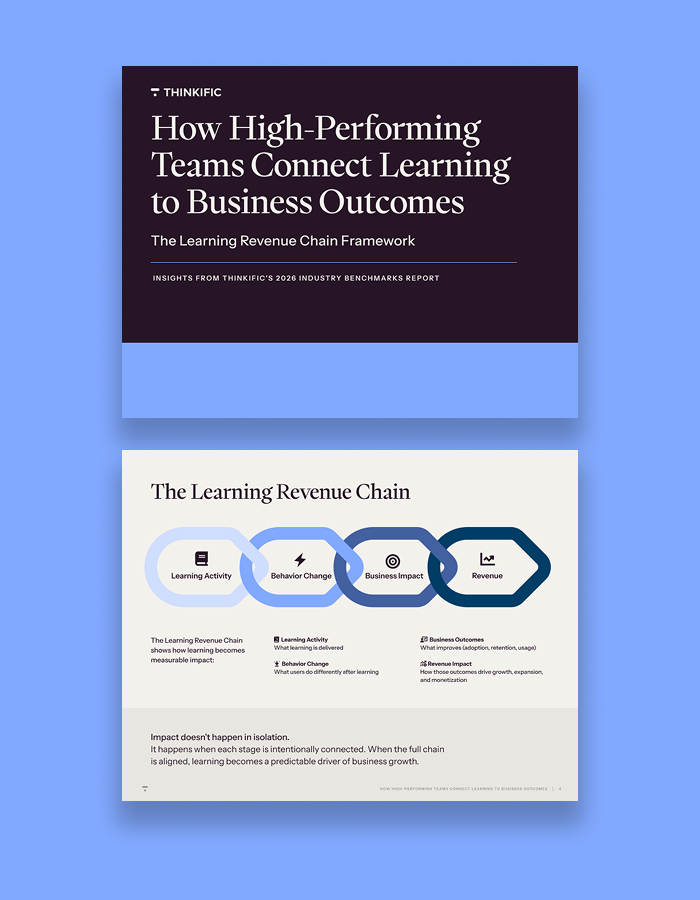
Learn how high-performing teams connect learning to business outcomes
98% of organizations say education impacts revenue, yet fewer than 1 in 3 can prove it. (Thinkific Benchmarks Report, 2026)
This guide explains why that gap exists: and gives you a practical framework for closing it.
Want to find out which link in your learning revenue chain is the weakest? Take the Learning Impact Assessment. You’ll also receive personalized next steps and templates to help you make a clear connection between your customer training and revenue impact.
Strategies to maximize customer training ROI
A well-built training program can always be refined. These four strategies consistently make the difference between a program that breaks even and one that generates a measurable return.
- Personalizing customer training
No two learners come to a product with the same background, role, or goals. When your training modules are tailored to specific industries, user types, or job functions, your customers will find the content more relevant to them and are more likely to apply what they learn.
Having role-specific or skill specific learning paths can also help, as it allows them to move through training that matches their actual workflow, which improves both completion rates and practical application. Many companies opt for “beginner, intermediate, and advanced” paths to give customers a clear progression through skillsets.
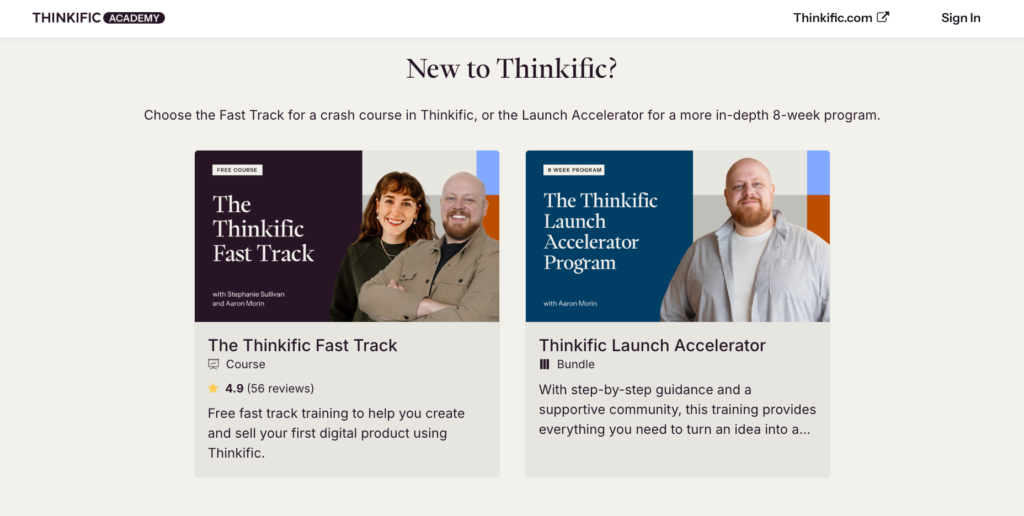
Example from Thinkific’s academy
If your team uses an LMS with certificate and digital badge capabilities like Thinkific Plus, you can also award certificates and badges to your customers to certify their learning and gamify the experience.
- Using effective training tools
Modern learning management systems/platforms (LMS) make it possible to deliver training that’s interactive and scalable at the same time. Incorporating video, quizzes, simulations, and downloadable resources gives customers multiple ways to engage with content and keeps completion rates higher than text-only formats.
The right platform also reduces the operational burden on your team. Automated enrollment, progress tracking, and certificate issuance happen without manual intervention, which makes it feasible to run training at scale.
- Offering certification programs
Certifications give customers a concrete goal to work toward and a credential they can use professionally. This increases their motivation to complete training and creates a visible signal: on LinkedIn, in HR systems, or in client-facing materials that the learner has demonstrated competency with your product.
When customers share their certifications, it also extends your program’s reach and social proof, positioning your organization as a credible source of professional development in your industry.
- Regular evaluation and updates
Training content that doesn’t keep pace with your product stops being useful, and customers notice. Regular evaluation of completion rates, assessment scores, and learner feedback surfaces where content is working and where it’s losing people.
Keeping content current isn’t just about adding new features. It’s about ensuring that the training you’re offering still reflects the actual workflows your customers are using, so the program continues to drive the adoption and retention outcomes that make the ROI case. This is especially important for supporting sustainable growth as your product and customer base evolve.
Case study: How Flashpoint educated 3,000+ users and enhanced product adoption with Thinkific Plus
Flashpoint is a data and intelligence company that equips businesses worldwide with the contextual intelligence they need to detect, prioritize, and remediate physical and cyber threats.
Customer success is central to Flashpoint’s business. If customers can’t effectively use the platform, the value of that intelligence can be lost.
The challenge: Flashpoint’s customer education program had grown alongside the company, but the methods they were using: in-person training and webinars, weren’t scaling. Each new customer required a significant investment of time and resources from the education team, and maintaining training quality while growing the user base was becoming difficult to manage.
“Before Thinkific Plus, we explored various methods of offering education. We needed a solution that could help us easily create and launch course content, with a team that was both helpful and responsive,” said Grace Tilmont, Director of Education Services at Flashpoint.
The approach: Flashpoint partnered with Thinkific Plus to build an on-demand online academy where customers could complete training at their own pace. They moved existing content into the platform using the course builder, developed role-specific learning paths for different user groups, separate tracks for analysts focused on data interpretation, and tracks for managers focused on reporting and strategic decision-making, and incorporated video, quizzes, and downloadable resources to support different learning styles.
The implementation was fast. The team quickly adapted to the platform, designed a training program that mirrored their software’s logical flow, and began onboarding new customers through the academy without the constraints of their previous model.
The results: Since launching on Thinkific Plus, Flashpoint has educated over 3,000 users, a scale that would have been impossible to reach with their previous resource-intensive approach.
“Using Thinkific Plus has allowed us to employ our customer education at scale. To date, we have educated over 3,000 users in our products and services. Without Thinkific Plus, it would have taken an immense amount of resources to train our user base,” said Grace Tilmont.
The impact extended beyond volume. Customers who completed training showed stronger product adoption from the start. The customer success team gained time back for complex, strategic work. The sales team could offer comprehensive training as part of the customer proposition. And the product team started receiving more informed feedback from users who had a deeper understanding of the platform.
“Teams that are utilizing the online course have much better buy-in from the get-go. They’re able to get more out of the product,” said Grace Tilmont.
Flashpoint’s experience reflects what the ROI calculation often misses: the returns from customer training compound over time. Reduced onboarding burden, higher product adoption, and a customer base that’s genuinely equipped to succeed all contribute to outcomes that show up in retention, expansion, and referral, not just in a single quarter’s numbers.
What strong customer training ROI looks like in practice
The return on customer training isn’t captured in just one metric. It shows up as fewer support escalations, faster time to value, higher renewal rates, and customers who actively expand their usage because they know what’s possible among many other customer success metrics. Each of those outcomes has a number behind it, and those numbers compound.
The companies that see the strongest ROI from customer education are the ones that treat it as an ongoing program, not just a one-time onboarding event. They measure what’s working, update content to match where the product is today, and build learning paths that reflect how different customer segments actually use the product.
That’s what separates a training program that pays for itself from one that’s hard to justify at budget time.
Build your customer education program with Thinkific Plus
Thinkific Plus gives customer success and learning teams the infrastructure to run a customer education program at scale: an intuitive course builder, automated enrollment, learning paths, certificates, analytics, and the integrations your team already relies on, all in one platform.
As your customer base grows, the program grows with it, without adding headcount or manual overhead.
Book a demo with the Thinkific Plus team to see how it works for your customer training program.
Frequently Asked Questions
- What is customer training ROI?
Customer Training ROI (Return on Investment) refers to the measurable value a business generates from investing in educating its customers about its products or services. It’s an evaluation of the financial outcomes from customer education compared to the resources required to deliver it — covering content creation, platform costs, team time, and ongoing maintenance.
- Why is it important to calculate the ROI of customer training?
Calculating the ROI of customer training is important because it moves the conversation from “we should do training” to “here’s what training returns.” This evaluation helps businesses identify which parts of their training program are working and which need improvement. It also gives learning teams the data to make strategic decisions about where to invest, how to allocate resources, and how to align training initiatives with broader business goals.
- How can an organization maximize its customer training ROI?
To improve customer training ROI, organizations can:
- Personalize training to match specific user roles, industries, or learning goals.
- Use modern e-learning tools to make training scalable, interactive, and easy to update.
- Offer certification programs to motivate completion and validate learner proficiency.
- Regularly evaluate and update training content to keep it current with product changes and learner needs.
- What are the benefits of customer training?
Customer training drives measurable outcomes across several areas of the business:
- Enhanced customer engagement: Trained customers use more of the product and engage more meaningfully with your team.
- Improved product adoption: Customers who know how to use a product use it more fully, reducing support volume and increasing realized value.
- Increased customer retention: When customers understand the product’s value for their specific use case, they’re less likely to churn.
- Up-selling and cross-selling opportunities: Confident, informed customers are more receptive to expanding their usage and exploring additional features or tiers.
- Can you cite an example of a successful customer training ROI?
Flashpoint, a data and intelligence company, partnered with Thinkific Plus to scale their customer education program after in-person training and webinars became too resource-intensive to sustain. By building an on-demand online academy with role-specific learning paths, they educated over 3,000 users while significantly reducing the resources required to deliver training. Customers who completed the online courses showed stronger product adoption from day one — and the customer success team gained capacity for higher-value work. You can read the full story in the Flashpoint case study.