

A CE administrator is preparing records for an upcoming accreditation review. Learner hours need to match reporting requirements, renewal timelines are approaching, and multiple departments are still submitting completion data manually. The training programs themselves are running. The challenge is maintaining accurate continuing education records across growing learner groups, recurring compliance deadlines, and changing reporting requirements.
That same pressure shows up across healthcare systems, financial services firms, legal organizations, professional associations, and other regulated industries. Continuing education requirements create ongoing administrative work, including CE credit tracking, approval workflows, reporting, audits, and renewal management. Most teams already have a process for managing continuing education. The challenge comes from maintaining accurate records, reporting, and renewal workflows as programs expand.
Compliance managers and CE administrators often spend significant time tracking CE credits across multiple programs, managing provider or course approvals, sending renewal reminders, preparing reports for regulators or accreditation bodies, reconciling learner records manually, and monitoring upcoming compliance deadlines.
The complexity continues to grow as continuing education requirements expand across larger workforces and certification programs.
Skip ahead:
- What is continuing education management software?
- Continuing education management vs. standard LMS functionality
- Why continuing education administration becomes difficult at scale
- The continuing education lifecycle
- Features to look for in continuing education management software
- Best continuing education management software platforms
- How to choose the right continuing education management software
- When CE management becomes part of broader learning operations
- Simplifying continuing education management at scale
What is continuing education management software?
Continuing education management software helps organizations administer ongoing education requirements across learners, credential programs, and regulated training environments.
These platforms support the operational side of continuing education management, including:
- CE credit tracking
- Learner progress monitoring
- Renewal requirements
- Compliance visibility
- Approval workflows
- Reporting and audit preparation
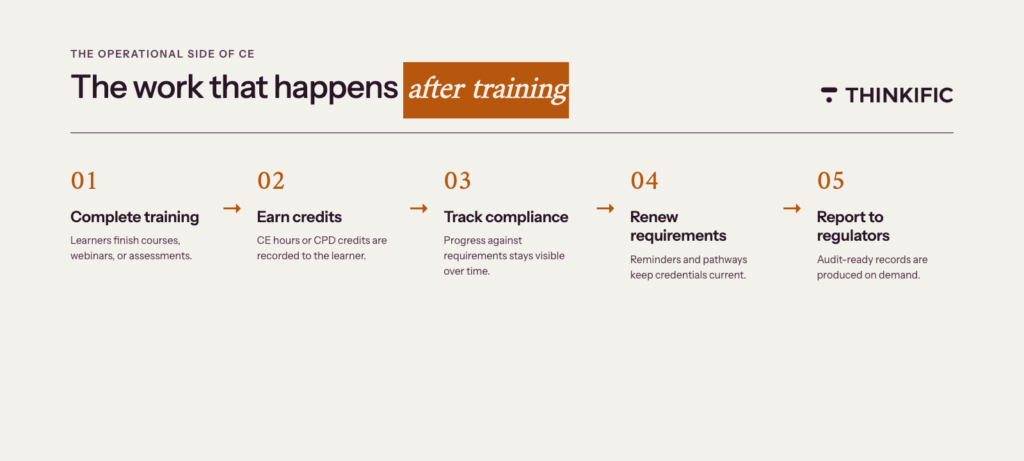
Many organizations already have systems for delivering courses or webinars. The operational challenge usually begins after training is completed, when administrators need to maintain accurate records, track recurring education requirements, and report on learner compliance over time.
That work often includes:
- Monitoring CE credit accumulation
- Tracking renewal timelines
- Managing provider or course approvals
- Preparing accreditation reports
- Responding to compliance reviews
- Maintaining audit-ready learner records
These platforms consolidate CE administration workflows that would otherwise sit across spreadsheets, LMS exports, email reminders, and disconnected reporting systems.
Most continuing education workflows follow a similar pattern:
This type of software is especially common in regulated professions where recurring education requirements affect licensing, certification status, or compliance standing.
Examples include:
- Nurses maintaining CE requirements for license renewal
- Financial advisors completing recurring compliance education
- Attorneys tracking CLE credits across reporting periods
- Corporate healthcare systems managing CE requirements across locations
- Professional associations administering member education programs
The category also overlaps with certification management, compliance training, and credential administration. Organizations researching broader certification workflows may also evaluate certification management software alongside CE management platforms.
Professional associations, healthcare organizations, financial services firms, accreditation bodies, and corporate compliance teams commonly use CE management software to simplify administration and improve compliance visibility.
A standard learning management system may support course delivery and completion tracking. Continuing education management software supports the ongoing administration required after learning takes place. The distinction becomes more noticeable once organizations manage recurring reporting deadlines, renewal cycles, and larger learner populations simultaneously.
Continuing education management vs. standard LMS functionality
Many organizations already use an LMS to host courses, manage enrollments, and track learner completions. Those capabilities are important, but continuing education administration usually requires additional operational oversight.
Traditional LMS functionality typically focuses on:
- Course hosting
- Learner enrollment
- Completion tracking
- Assessments and quizzes
- Basic reporting
Continuing education management software supports a separate layer of administration for recurring compliance requirements and long-term learner tracking.
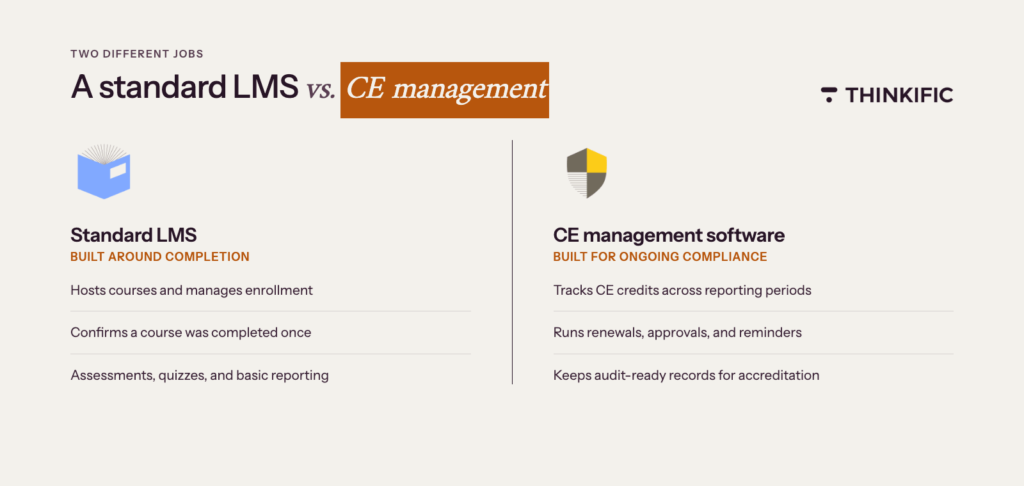
That often includes:
- CE credit tracking
- Renewal timelines
- Compliance visibility
- Approval workflows
- Accreditation reporting
- Audit-ready learner records
- Recurring education management
Most LMS platforms are built around course completion. CE administrators need systems designed for ongoing compliance management.
For example, a standard LMS may confirm that an employee completed a compliance course once. A CE management platform tracks whether that employee continues meeting annual education requirements across multiple reporting periods.
Accredited education programs create additional administrative requirements tied to CE tracking, renewal cycles, reporting standards, and learner compliance status.
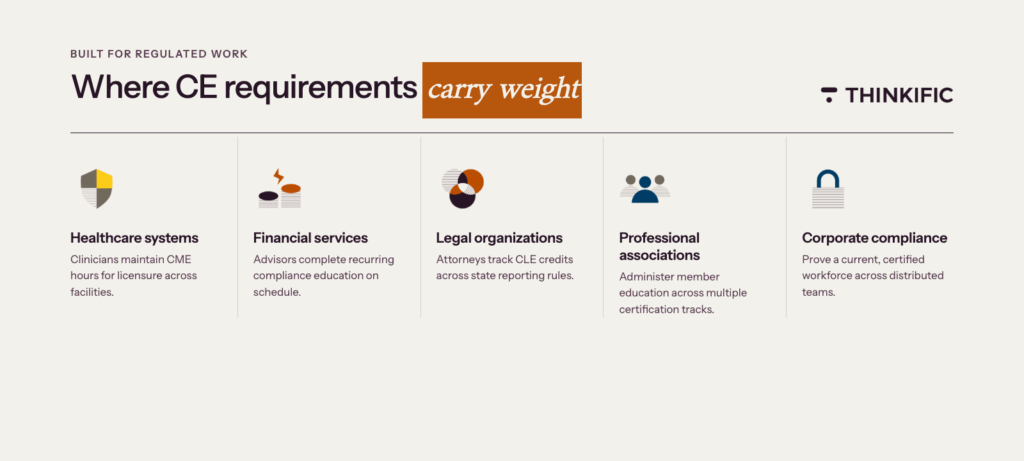
This becomes especially important for:
- Healthcare CE administration
- Legal CLE tracking
- Financial services compliance education
- Professional association learning programs
- Corporate compliance training operations
Some organizations manage these workflows through a combination of LMS tools, reporting systems, and manual tracking. Others look for platforms that combine CE administration with broader learning delivery and learner engagement capabilities.
Teams planning for long-term program growth often compare CE administration tools alongside platforms designed for broader learning delivery, learner engagement, and certification workflows. Teams comparing broader education delivery tools may also evaluate continuing education LMS platforms alongside CE administration software.
Why continuing education administration becomes difficult at scale
Many continuing education programs start with processes that feel manageable.
A spreadsheet tracks CE credits. Renewal reminders go out through email. Learner records sit across LMS exports, shared drives, or internal reporting systems. Someone on the team manually reconciles credit hours before reporting deadlines or accreditation reviews.
That process can work for smaller learner groups or limited certification programs.
The complexity changes as organizations manage more learners, additional reporting periods, multiple credential pathways, or recurring compliance requirements across departments and regions.
A healthcare system may need to track clinicians’ CE compliance across multiple facilities. A professional association might support several certification pathways with different reporting timelines and renewal requirements.
Financial services firms often monitor annual regulatory education requirements across distributed teams, while legal training departments may track CLE compliance across offices operating under different state rules.
The administrative workload grows as the program expands.
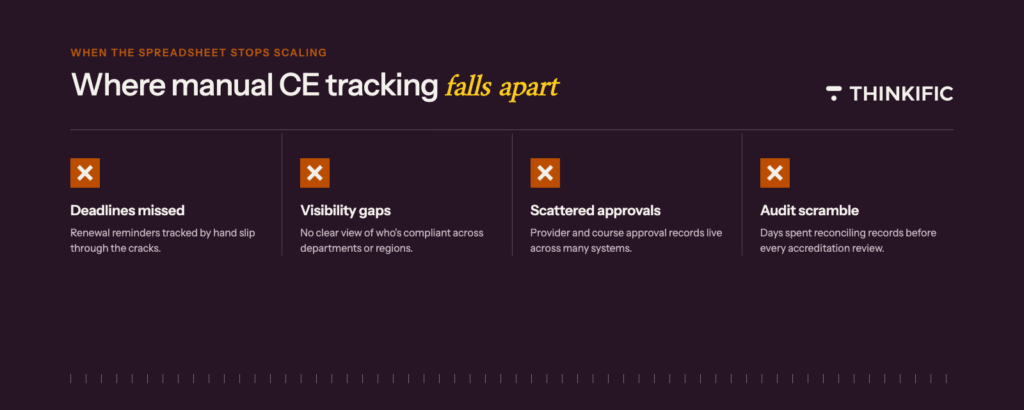
Common friction points start to appear:
- CE deadlines missed because reminders were tracked manually
- Compliance visibility gaps across departments or learner groups
- Learners unsure of their current CE status
- Manual reporting workloads before audits or accreditation reviews
- Provider approval records spread across multiple systems
- Regulatory reporting requirements changing across jurisdictions
- Difficulty tracking distributed learners across locations or business units
Most of these issues do not come from poorly managed programs. The challenge is recurring administrative complexity across ongoing education requirements.
Accreditation reviews and compliance audits often expose those gaps most clearly. Teams may spend days pulling together learner records, reconciling CE credits, validating approvals, or confirming renewal timelines before reporting deadlines.
Manual CE administration also creates more follow-up work for learners themselves. Employees, members, or licensed professionals may struggle to confirm completed credits, locate renewal requirements, or understand whether they remain compliant.
Continuing education management software helps reduce that administrative burden by centralizing records, automating reminders, tracking compliance, and improving reporting workflows across ongoing education programs.
The continuing education lifecycle
Continuing education programs require more than course delivery. Most teams also need a way to manage recurring education requirements, learner communication, compliance tracking, and reporting across ongoing certification or licensing cycles.
That turns CE management into an ongoing operational process instead of a one-time training event.
Delivering continuing education programs
Continuing education delivery often spans multiple learner groups, reporting periods, and training formats.
Some organizations manage annual compliance training for employees. Others support accredited professional development programs, partner certification initiatives, or continuing medical education across distributed learner populations.
Program delivery may include:
- Self-paced learning modules
- Live virtual sessions
- Cohort-based learning
- Blended learning formats
- Recurring education pathways
- Multi-program academy management
Healthcare organizations may deliver continuing medical education across departments and specialties, while legal or financial organizations often manage recurring ethics and regulatory education programs tied to annual reporting requirements.
Platforms like Thinkific support those workflows through scalable learning delivery, learner progress tracking, Communities, Coaching and Webinars, and flexible learning product management.
Tracking CE credits and learner compliance
Tracking CE credits becomes more complicated once organizations manage multiple reporting timelines, credential pathways, or regulatory requirements.
Administrators need visibility into:
- Who remains compliant
- Which learners are approaching deadlines
- Where reporting gaps exist
- How many credits learners have completed
- Which requirements still remain outstanding
That visibility becomes difficult to maintain when learner records sit across disconnected systems or manual spreadsheets.
Centralized CE tracking helps teams monitor learner progress and maintain clearer compliance reporting. This is especially important for industries where education requirements directly affect licensing, certification status, or regulatory standing.
Examples include:
- Healthcare CE hour tracking
- CLE tracking for attorneys
- Financial compliance education records
- Workforce safety certification monitoring
Some teams also need visibility across departments, offices, or regions simultaneously. A corporate healthcare system may manage CE requirements across multiple facilities, while a professional association could oversee several certification tracks with different renewal requirements and reporting timelines.
Teams also need visibility into approaching renewal deadlines before compliance gaps appear.
Managing reminders, approvals, and reporting
Administrative work often increases after training is completed.
Many CE teams spend significant time managing renewal reminders, approval workflows, accreditation documentation, and recurring reporting requirements tied to ongoing education programs.
That work commonly includes:
- Sending learner notifications before renewal deadlines
- Tracking provider or course approvals
- Preparing accreditation reports
- Maintaining audit-ready learner records
- Monitoring reporting deadlines
- Verifying completed CE credits
Reporting and renewal administration can consume more time than the learning delivery itself, especially for organizations managing large learner populations or recurring regulatory reporting cycles.
Accreditation reviews often add another layer of complexity. Teams may need to reconcile learner records, validate CE hours, confirm approval documentation, and prepare reporting data across multiple systems before submission deadlines.
Automated reminders and centralized reporting workflows help reduce that administrative burden. Learners receive clearer visibility into upcoming requirements, while administrators gain a more reliable view of compliance status across programs.
This becomes especially valuable for:
- Provider approval management
- Accreditation reporting preparation
- Renewal notifications tied to CE requirements
- Multi-program compliance reporting
- Distributed learner administration
Features to look for in continuing education management software
Continuing education platforms vary widely in what they support. Some focus heavily on course delivery, while others provide deeper tools for CE administration, compliance reporting, and recurring education management.
The right fit depends on how your organization manages continuing education today and the level of administrative complexity your team needs to support over time.
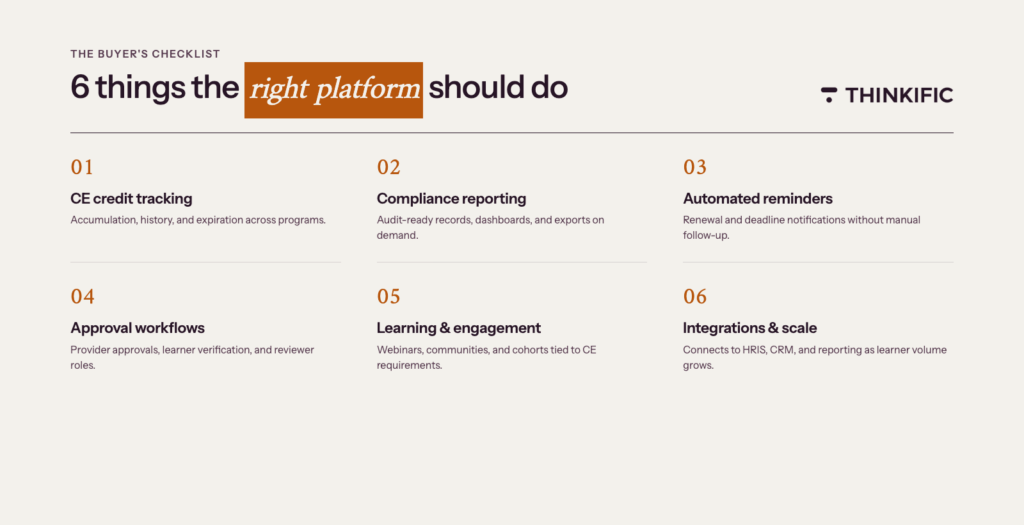
CE credit tracking
CE credit tracking sits at the center of most continuing education operations.
Administrators need a reliable way to monitor completed credits, renewal timelines, learner progress, and outstanding education requirements across multiple reporting periods.
Key capabilities to look for include:
- Credit accumulation tracking
- Learner credit history
- Expiration tracking
- Renewal requirement monitoring
- Multi-program CE management
Managing multiple certification pathways or reporting standards quickly increases administrative complexity. A healthcare organization may track CE hours across departments and specialties, while a professional association could manage different renewal requirements across multiple member certifications.
Centralized learner records help teams identify approaching deadlines earlier.
Compliance visibility and reporting
Compliance reporting often becomes one of the most time-consuming parts of CE administration.
Training teams, accreditation bodies, compliance managers, and regulators may all need access to different reporting views tied to learner activity and CE status. Pulling that information manually across disconnected systems creates additional work during reporting periods and accreditation reviews.
Useful reporting features often include:
- Audit-ready learner records
- Compliance dashboards
- Exportable reporting
- Accreditation reporting support
- Centralized learner data
Reporting only helps when teams can quickly identify compliance gaps and approaching deadlines.
Automated reminders and learner communication
Continuing education programs involve recurring deadlines and ongoing learner communication.
Automated reminders reduce manual follow-up and give learners clearer visibility into upcoming CE requirements. This becomes increasingly valuable for organizations managing large learner groups or recurring renewal cycles.
Common communication features include:
- Renewal reminders
- Deadline notifications
- Recurring CE alerts
- Learner messaging workflows
- Email Automation
Some organizations use automated communication year-round to keep learners engaged between renewal cycles.
Approval workflows and administration tools
Approval management can add significant administrative overhead.
Continuing education teams may need to manage provider approvals, verify learner eligibility, review submitted credits, or coordinate multiple administrative roles across departments and programs.
Platforms with stronger administrative controls typically support:
- Provider approval tracking
- Program approval workflows
- Learner verification
- Administrator permissions
- Workflow management tools
These capabilities are especially useful for accreditation organizations, professional associations, and enterprise training teams managing multiple reviewers or reporting standards.
Learning delivery and learner engagement
Many continuing education programs require more than static course delivery.
Organizations often support live webinars, recurring training events, cohort-based learning, or ongoing professional development libraries tied to CE requirements. Learners may also need mobile access or self-service visibility into completed education activity.
Features that support stronger learner engagement may include:
- Webinars and live sessions
- Learning libraries
- Cohort programs
- Communities
- Mobile learner access
- Scalable academy management
Platforms like Thinkific combine continuing education delivery with learner engagement tools that help organizations manage recurring education programs across larger learner groups.
Integrations and scalability
Continuing education administration rarely operates in isolation.
Many organizations need CE data connected to HR systems, reporting tools, CRMs, compliance workflows, or existing learning platforms. Integration requirements often expand as learner volumes and reporting complexity increase.
Look for platforms that support:
- LMS integrations
- HRIS integrations
- CRM compatibility
- Reporting integrations
- Multi-team administration
- Distributed learner support
Scalability matters as organizations expand CE programs across departments, regions, certification tracks, or partner networks. A platform that works for a single continuing education program may become harder to manage once reporting requirements and learner populations grow significantly.
Best continuing education management software platforms
Continuing education management platforms approach the category from different angles. Some focus heavily on accreditation reporting and compliance tracking, while others combine CE administration with broader learning delivery and learner engagement tools.
The right fit depends on how your organization manages continuing education today, the level of administrative complexity you need to support, and whether CE programs align closely with broader learning operations.
One quick note before diving in: Thinkific is included in this list because it supports scalable continuing education delivery, learner engagement, and recurring education management workflows. Some of the other platforms below specialize more heavily in accreditation administration or compliance-specific reporting.
Continuing education management software comparison table
| Platform | Best for | Key strengths | CE management support | Considerations |
|---|---|---|---|---|
| Thinkific | Scalable continuing education programs and learner engagement | Learning products, Coaching and Webinars, Communities, Email Automation, reporting | CE delivery, learner management, certification pathways, recurring education workflows | Less focused on niche accreditation database management |
| EthosCE | Professional associations and accredited CE programs | Accreditation workflows, association management, CE tracking | Credit tracking, accreditation reporting, compliance workflows | More association-focused than broader learning experience platforms |
| Blue Sky eLearn | Healthcare and professional continuing education | CME workflows, accreditation support, learner reporting | Healthcare CE administration, reporting, learner compliance tracking | Primarily focused on healthcare and accredited professional education |
| LearnUpon | Corporate compliance and workforce education | Employee training, compliance reporting, integrations | Workforce education management, recurring compliance training | More workforce-focused than association or member education programs |
| Moodle Workplace | Customizable enterprise learning and compliance workflows | Flexibility, role management, extensibility | Configurable CE and compliance workflows | May require more administrative setup and customization |
| TalentLMS | Internal CE and employee certification tracking | Simplicity, workforce training, onboarding | CE tracking, recurring employee education | Less specialized for accreditation-heavy CE environments |
| Canvas + Credentials | Academic and credential-connected learning | Credential integrations, learner records, education delivery | CE delivery tied to credential workflows | Often works best within academic or institutional ecosystems |
Thinkific
Thinkific works well for organizations that want continuing education management connected to scalable learning delivery and learner engagement.
Many continuing education programs involve more than just credit tracking. Teams often need one platform for course delivery, learner communication, certification pathways, recurring education programs, and reporting visibility.
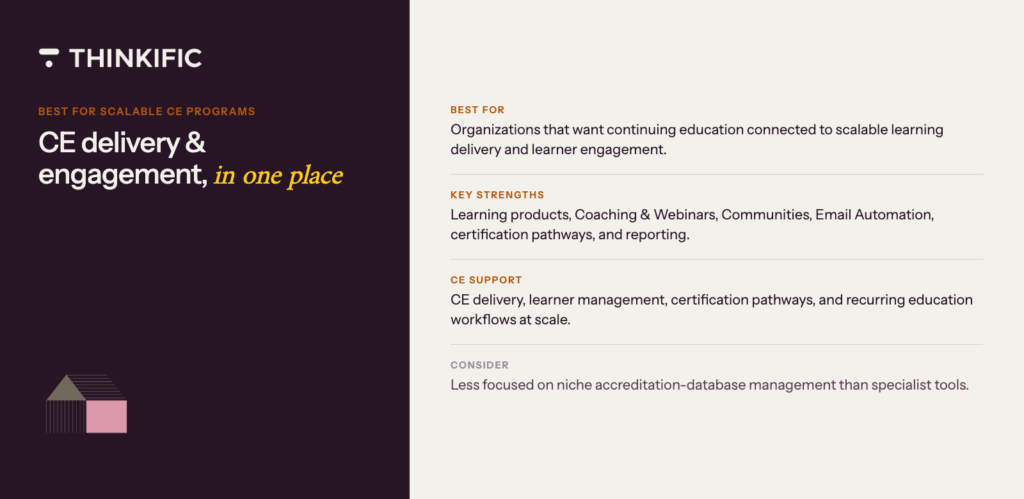
Thinkific supports those workflows with:
- Learning products
- Coaching and Webinars
- Communities
- Email Automation
- Learner engagement tools
- Certification pathways
- Scalable academy management
- Reporting and integrations
This makes Thinkific a strong fit for:
- Continuing medical education programs
- Professional development organizations
- Customer education academies
- Partner certification initiatives
- Corporate compliance training teams
- Association learning programs
Organizations managing highly specialized accreditation databases or regulator-specific reporting systems may still require additional tooling alongside their learning platform.
EthosCE
EthosCE focuses heavily on continuing education administration for professional associations, healthcare organizations, and accredited CE providers.
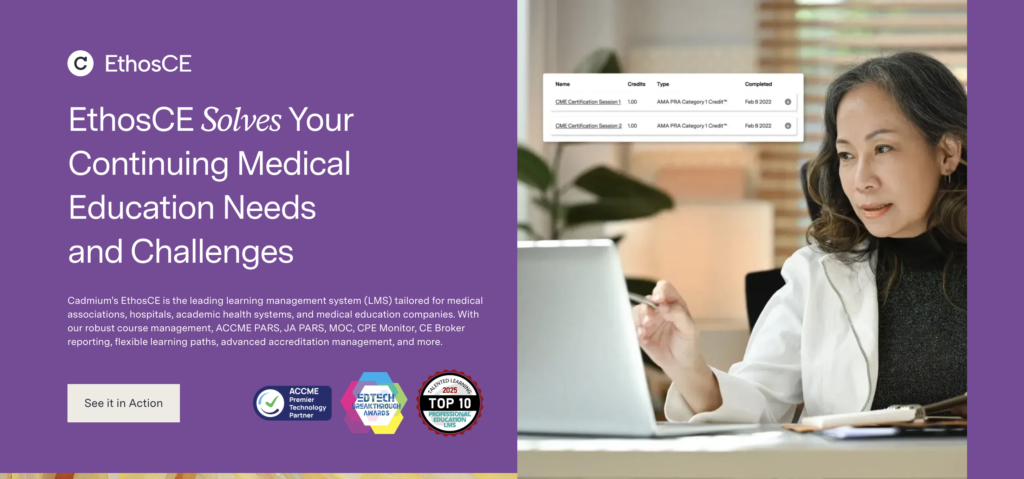
The platform includes tools for:
- CE credit tracking
- Accreditation workflows
- Certification management
- Learner reporting
- Event and program administration
Association-driven organizations often use EthosCE when accreditation reporting and member education management are central operational requirements.
Blue Sky eLearn
Blue Sky eLearn is commonly used in healthcare and professional continuing education environments.
The platform supports:
- Continuing medical education administration
- Accreditation workflows
- Compliance reporting
- Learner record management
- CE tracking across professional programs
Healthcare organizations and accredited training providers often use Blue Sky eLearn for professional licensing and CE administration focused on compliance.
LearnUpon
LearnUpon is geared toward corporate training, workforce compliance, and employee education management.
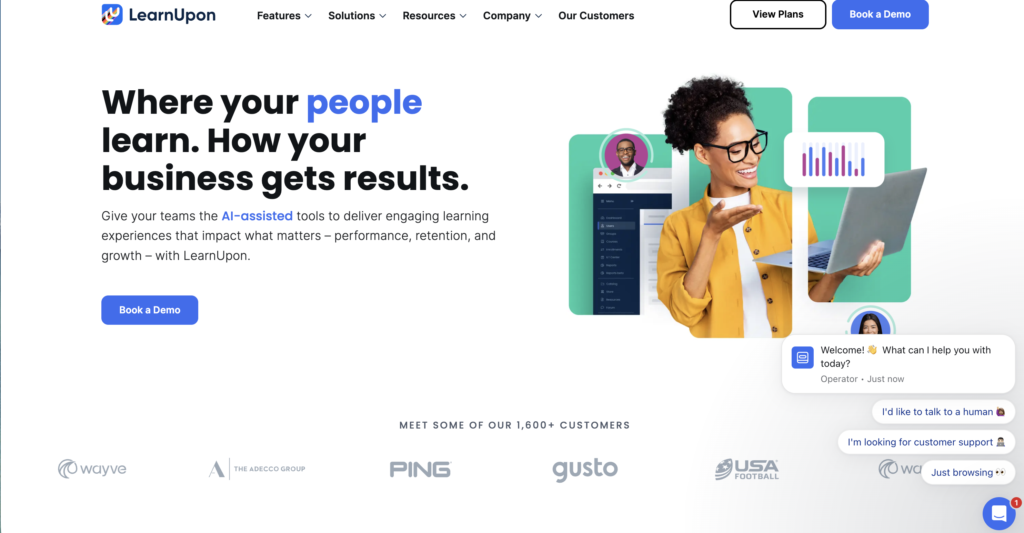
The platform supports:
- Employee training delivery
- Compliance education
- Learner reporting
- Recurring workforce training
- Administrative visibility across teams
Organizations focused primarily on internal workforce education often use LearnUpon to manage both recurring compliance requirements and continuing education programs.
Moodle Workplace
Moodle Workplace offers a more customizable approach to continuing education and compliance management. Our Thinkific vs. Moodle comparison covers where Moodle Workplace fits and what it takes to run.
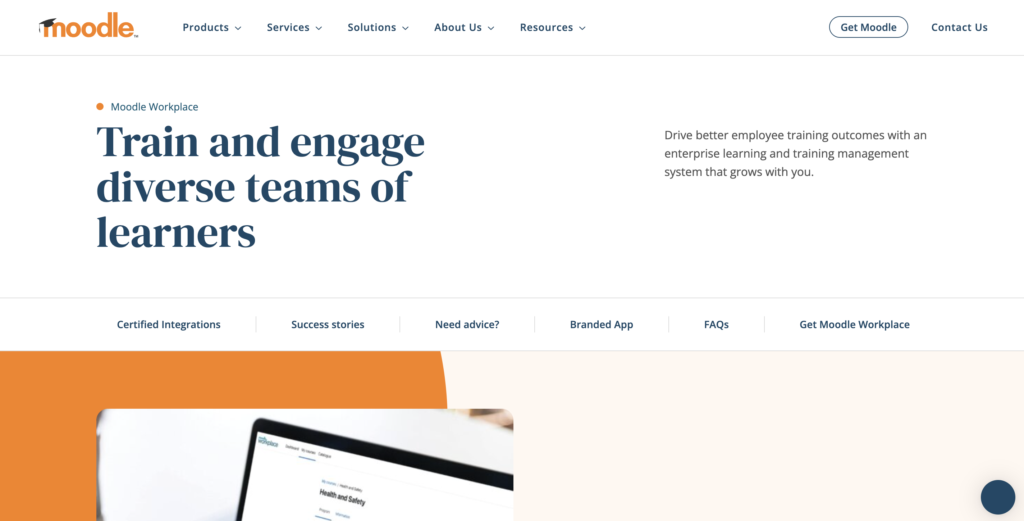
Organizations can configure:
- Learning pathways
- Role-based administration
- Compliance workflows
- Department-specific reporting
- Certification tracking
This flexibility appeals to organizations with complex internal structures or highly customized CE requirements.
TalentLMS
TalentLMS focuses on workforce learning and employee training management.
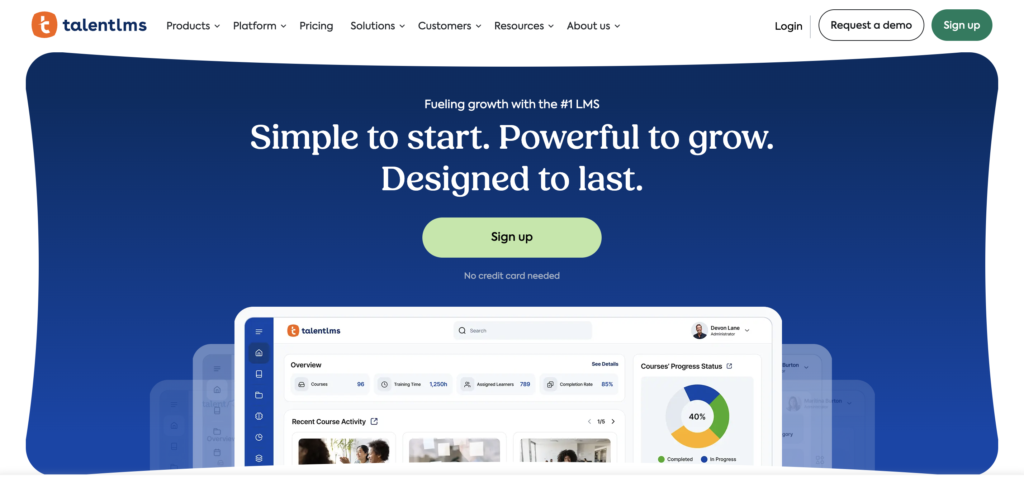
The platform supports:
- Internal certification tracking
- Employee onboarding
- Compliance education
- Recurring training workflows
- Learner progress reporting
Teams looking for a lighter-weight solution for internal continuing education programs often consider TalentLMS because of its simplicity and ease of administration. Our Thinkific vs. TalentLMS comparison covers where it fits and where external CE programs may need more.
Canvas + Credentials
Canvas, when combined with credential tools, supports the delivery of continuing education closely tied to academic and credential-based learning environments.
Organizations may use this setup for:
- Academic continuing education
- Professional learning programs
- Credential-connected education delivery
- Learner progress and achievement tracking
This approach often works best for institutions already operating within broader academic or institutional learning ecosystems.
How to choose the right continuing education management software
The best continuing education management platform depends heavily on how your organization manages compliance requirements, learner reporting, and recurring education programs over time.
Some teams primarily need CE credit tracking and renewal reminders. Others manage accreditation reporting, distributed learner populations, multiple certification pathways, or recurring compliance reviews across departments and regions.
Operational complexity usually reveals what matters most.
A healthcare organization managing CE across multiple facilities may prioritize centralized reporting and visibility into learner compliance. A professional association might need approval workflows and member certification tracking, while a corporate compliance team could focus more heavily on workforce education, learner communication, and recurring reporting requirements.
Questions like these can help narrow the field:
- How many learners require CE tracking?
- Are CE credits tied to license renewal or certification requirements?
- How frequently do regulators or accreditation bodies request reporting?
- Does the organization manage multiple CE programs simultaneously?
- Are approval workflows part of the administration process?
- Do learners need self-service access to CE history and compliance status?
- Does the platform also need to support broader learning programs?
- Will multiple administrators or departments manage CE records?
The answers usually clarify whether your team needs a lightweight CE tracking tool, a compliance-focused reporting platform, or a broader learning environment that supports ongoing continuing education management.
Learning delivery often becomes part of that decision, too.
Many CE programs involve recurring communication, learner engagement, certification pathways, and long-term participation alongside compliance administration. Teams frequently benefit from platforms that connect CE administration with broader learning delivery and learner engagement workflows, rather than managing those systems separately.
When CE management becomes part of broader learning operations
Continuing education programs rarely operate independently forever.
Organizations often start with a single compliance requirement or certification pathway, then expand into broader education programs that involve learner engagement, recurring communication, and ongoing training delivery.
A healthcare organization may begin with annual CE compliance tracking, then add onboarding education, continuing medical education libraries, and recurring workforce development programs. Professional associations often grow from certification management into member learning hubs that include webinars, communities, and ongoing professional development pathways.
That operational overlap is where learning platforms become part of the continuing education conversation.
Platforms like Thinkific support continuing education delivery, learner engagement, and scalable academy management. Teams can combine Coaching and Webinars, cohort programs, Communities, Email Automation, certification pathways, reporting and integrations, and branded academy experiences within the same learning environment.
This becomes especially valuable for organizations managing:
- Workforce compliance education
- Professional development initiatives
- Customer certification programs
- Partner training programs
Teams planning for long-term CE program growth often need more than just compliance tracking. Learner communication, reporting visibility, and scalable education delivery all become part of the operational workload over time.
Organizations researching broader compliance and certification workflows may also compare continuing education platforms alongside resources on compliance training software and certification management software as learning operations expand across multiple programs and learner groups.
Simplifying continuing education management at scale
The administrative burden of continuing education doesn’t come from running the programs. It comes from what happens after: tracking compliance across disconnected systems, reconciling learner records before audits, and managing renewal cycles that were never designed to run at scale. When those workflows are centralized and automated, the operational work shifts from damage control to oversight.
That’s what CE administration looks like when the infrastructure is doing its job.
Put Thinkific behind your continuing education program
Thinkific supports the full CE workflow from a single platform: recurring course delivery, certification pathways, Email Automation for renewal communication, and learner engagement tools that keep teams and members active between compliance cycles. Organizations managing CE across departments, regions, or member populations can run delivery and compliance tracking without splitting the program across separate tools.
Start a free trial or book a demo with the Thinkific Plus team.