
When your customer education or employee training program reaches a certain scale, the limitations of your current LMS stop being an inconvenience and start affecting revenue. Renewal rates slip. Learner completion drops. Reporting gaps make it harder to justify the program budget.
Skilljar is a capable platform for customer training, but it isn’t the right fit for every organization. Some teams need deeper integration with their CRM stack. Others want more flexibility in how they structure learning paths. And many find that pricing scales faster than the value it delivers.
This guide covers the most relevant Skilljar alternatives for organizations running customer education, partner training, or employee development programs at scale. We’ll break down the features that matter, the platforms worth considering, and what to look for in each.
- Key features to look for in Skilljar alternatives
- Comparing top Skilljar alternatives
- Case studies
- Future of learning management systems
- FAQs
Key features to look for in Skilljar alternatives
When researching Skilljar vs other platforms, it’s important to consider your organization’s unique needs. Here are some essential features to look for to help ensure the platform you choose can effectively support your specific learning management requirements.
1. Customization and flexibility
Personalized learning experiences are paramount. An LMS should offer extensive options to customize courses, allowing them to be tailored with your organization’s branding and unique content.
Pay attention to features like editable learning paths and customizable certificates that align with your training goals. They should also support various content formats to accommodate various learning preferences, from videos and interactive modules to quizzes and text-based documents.
Your LMS should be able to scale up effortlessly as your user base grows and your training needs become more sophisticated. The ideal platform would stay current with the latest trends, like mobile learning, social learning, and gamification, ensuring it remains relevant and effective.
2. User interface and experience
A Skilljar competitor’s user interface is a direct reflection of its potential for success. It should boast an intuitive layout that learners and instructors can understand swiftly, eliminating any unnecessary complexity hindering the learning process.
All users, regardless of their technological proficiency or disabilities, should be able to access the platform and understand how to operate within it.
3. Integration capabilities
Given the interconnected nature of business tools today, the ability to integrate smoothly with other systems—such as CRM, HRIS, or marketing automation software—can drastically improve efficiency and data coherence.
An LMS that offers API access and has pre-built integrations with commonly used business systems will ensure you can connect to the larger ecosystem of your organizational tools.
Comparing top Skilljar alternatives
When evaluating Skilljar alternatives, it’s important to consider the array of options that align with your specific learning management needs. Each alternative brings its unique blend of features, pricing models, and user experiences to the table.
| Platform | Key Features | Best For | Price Range |
| Thinkific Plus | Customizable course creation Branded mobile app creationIntegrated e-commerce | Growing businessesMobile learningEngagement-driven education | Contact for quote |
| LearnUpon | Unified learning platformFlexible learning pathsRobust reporting | Corporate trainingExtended enterpriseCompliance management | Scales based on user count |
| Docebo | AI-driven learning pathsSocial learning capabilitiesExtensive integrations | Learning at scaleInnovative approachesTech-forward enterprises | Three-tiered structure based on user count |
| TalentLMS | Course authoring tools Automation and notifications Multi-tenant portals | SMBs and mid-market Customer and partner training Budget-conscious buyers | From $69/month |
| Absorb LMS | Intelligent automation Absorb Infuse embedding Advanced analytics | Enterprise organizations Compliance-heavy programs Extended enterprise training | Contact for quote |
| Cornerstone OnDemand | Content marketplace AI skills graph Compliance management | Large enterprises HR-driven L&D programs Global organizations | Contact for quote |
Related:
1. Thinkific Plus

Thinkific Plus is a powerful, scalable online course platform designed for businesses looking to deliver high-quality training experiences. The platform offers a seamless way to create, market, and sell online courses.
It’s built for individual educators and large organizations seeking to deliver professional training or educational courses at scale. Thinkific Plus is known for its robust, easy-to-use course builder, a comprehensive set of sales and marketing tools, and exceptional customer support.
Key features:
- Customizable course creation: Offers extensive branding and design options to match company aesthetics and learner engagement preferences.
- Branded Mobile: Create a white-label app for your online courses and communities.
- Integrated e-commerce tools: Provides built-in payment processing and multiple sales options, including memberships and course bundles.
Best for:
- Growing businesses: Ideal for entrepreneurs and SMBs expanding their online learning offerings.
- Mobile learning: Learners can connect with their course material through a variety of platforms and devices.
- Engagement-driven education: Great for businesses that prioritize keeping learners engaged and motivated through interactive courses.
Price range:
Thinkific Plus takes a tiered approach to pricing, offering different plans to fit various business sizes and needs. The plans start with basic functionality and ramp up to more advanced features, including white labeling, advanced integrations, and full analytics.
Contact Thinkific for bespoke pricing, but rest assured, there’s a plan structured to provide value whether you’re just starting out or scaling up your operations.
Related: Learn how Thinkific Plus helps streamline customer education, increase activation, and reduce churn.
Conclusion
Thinkific Plus is a compelling Skilljar alternative emphasizing user-friendly course creation, robust sales opportunities, and a high degree of customizability. It’s especially suitable for those seeking a platform that combines strong e-commerce capabilities with effective learning management.
2. LearnUpon

LearnUpon is a versatile learning management system alternative designed to help businesses develop, deliver, and track staff training. It is also widely used for customer and partner training, distinguishing itself with its commitment to creating a memorable learning experience for all users.
Its feature-rich platform is engineered for companies of all sizes, aiming to align training with their business goals.
Key features:
- Unified learning platform: Centralizes the training process for employees, customers, and partners in one accessible platform.
- Flexible learning paths: Provides tools to create structured learning paths for different user groups, enabling personalized learning experiences.
- Robust reporting: Offers in-depth tracking and reporting capabilities for administrators to monitor learner progress and training impact.
Best for:
- Corporate training: Perfect for businesses eager to develop and track employee training programs rigorously.
- Extended enterprise: Designed for organizations that train external stakeholders, such as customers and partners.
- Compliance management: A strong fit for companies that require meticulous record-keeping for compliance training purposes.
Price range:
LearnUpon’s pricing model is based on the number of active users and the level of features required by the business. There are three levels—Essential, Premium, and Enterprise—for 150, 150-500, and 500+ users, respectively.
For a detailed quote tailored to specific organizational requirements, LearnUpon advises contacting their sales team.
Conclusion
LearnUpon is a solid Skilljar alternative for organizations demanding a comprehensive, all-in-one LMS that aligns training efforts with business objectives.
Its strength in providing combined training solutions across different segments, paired with robust reporting functions, makes LearnUpon a top contender for businesses serious about the measurable impact of their learning initiatives.
Go deeper: Compare Thinkific vs LearnUpon
3. Docebo
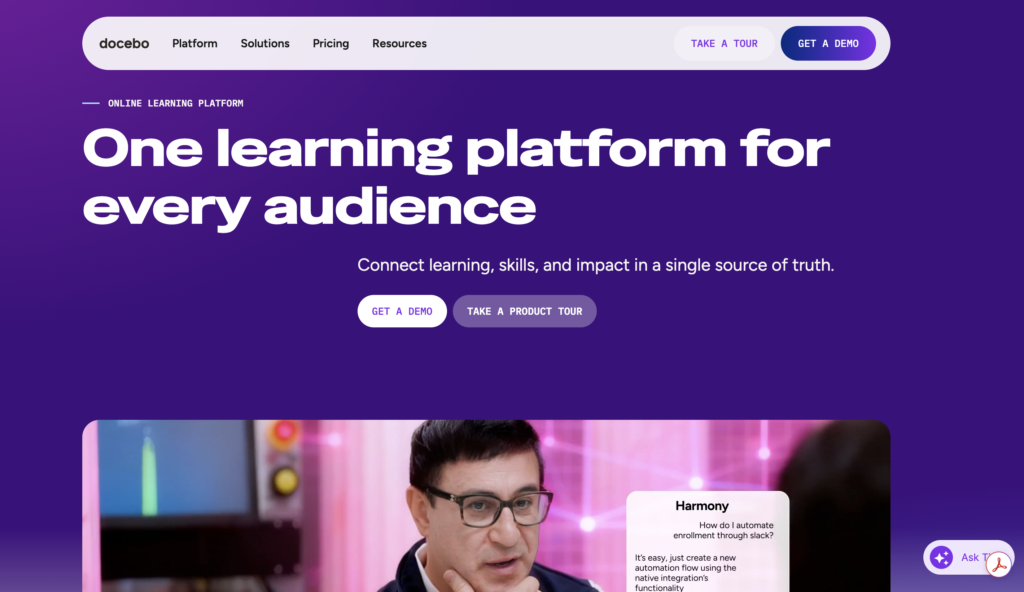
Docebo is an AI-powered learning platform that delivers a personalized and automated learning experience at scale. It engages the learner while providing administrators powerful tools to manage, deliver, and track training more effectively.
Aimed at mid-to-large-sized companies, Docebo is highly regarded for its sleek user interface and robust feature set, including gamification, social learning, and integration capabilities.
Key features:
- AI-driven learning paths: Uses artificial intelligence to recommend content and create adaptive user learning experiences.
- Social learning capabilities: Encourages knowledge sharing and collaboration among learners with features that mimic social network functionalities.
- Extensive integrations: Seamlessly integrates with a wide range of enterprise software, enhancing the platform’s utility within diverse business ecosystems.
Best for:
- Learning at scale: Best suited for larger organizations needing scalable solutions to train numerous employees or clients worldwide.
- Innovative learning approaches: Ideal for companies looking to leverage AI and social learning to enhance their training programs.
- Tech-forward enterprises: Designed for businesses seeking a sophisticated, future-oriented LMS that easily integrates with other enterprise tools.
Price range:
Designed with enterprise needs in mind, they have a flexible pricing structure catering to various business sizes and training complexities. Prospective customers should reach out to Docebo directly for a custom quote.
Conclusion
Docebo is an attractive option for businesses investing in cutting-edge, AI-driven learning management system alternatives. With its advanced personalization and social learning features, Docebo is particularly well-suited for organizations looking to create dynamic, interactive, and automated learning experiences at scale.
Go deeper: Docebo Alternatives
4. TalentLMS

TalentLMS is a cloud-based LMS used by over 70,000 organizations globally. It’s built for businesses that need to train employees, customers, and partners without the operational overhead of larger enterprise platforms. The setup is fast, the interface is clean, and it handles multiple training use cases — from onboarding to compliance to customer education — within a single account.
Where Skilljar focuses heavily on customer education with a polished learner experience, TalentLMS offers more flexibility across use cases at a lower price point. Teams running mixed training programs — internal and external — often find the multi-portal architecture especially useful.
- Course authoring tools: Built-in editor lets teams build courses directly in the platform without external authoring software.
- Automation and notifications: Automates enrollment, reminders, and certification renewals to reduce manual admin work.
- Multi-tenant portals: Supports separate branded portals for different audiences — customers, partners, or internal business units — from one account.
Best for:
- SMBs and mid-market teams: Organizations that need a capable LMS without the implementation complexity of enterprise platforms.
- Customer and partner training: Teams running external education programs alongside internal training in one platform.
- Budget-conscious buyers: Transparent, per-active-user pricing that scales predictably as programs grow.
Price range:
TalentLMS uses a per-active-user pricing model with a free plan available for up to five users. Paid plans start around $69/month, with higher tiers unlocking advanced reporting, SSO, and automation features.
5. Absorb LMS
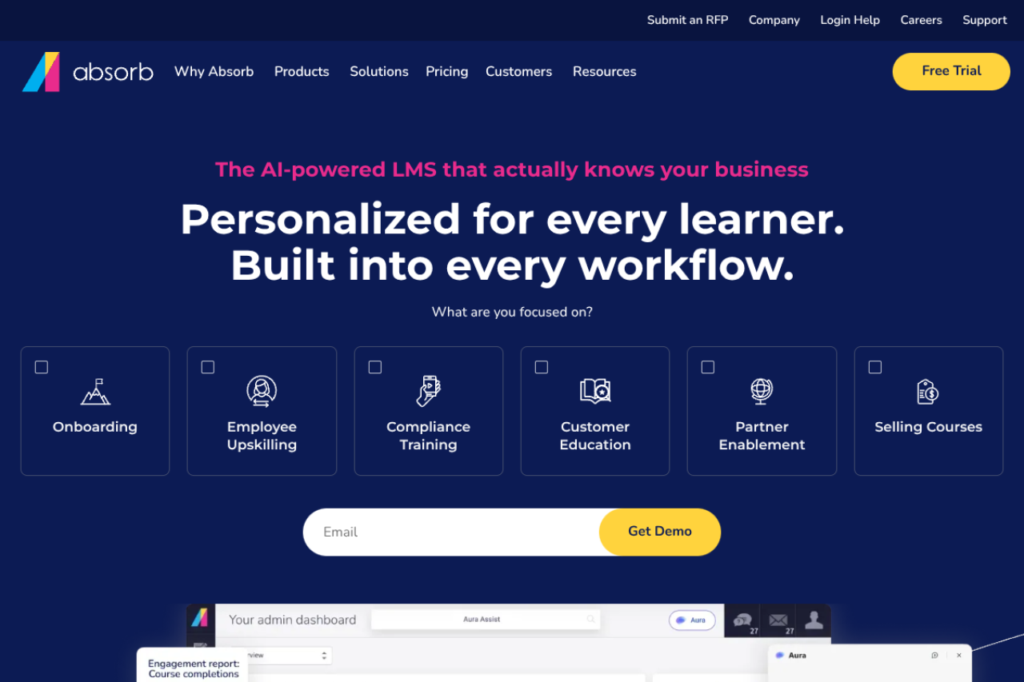
Absorb LMS is an enterprise learning platform built around reducing the administrative burden of running large training programs. It’s designed for organizations that need strong workflow automation, clean learner-facing experiences, and detailed reporting — without dedicating significant L&D headcount to keeping the system running.
Compared to Skilljar, Absorb puts more emphasis on the administrative and analytics side of enterprise training. It’s a strong fit for organizations where training outcomes need to be tied to measurable business metrics and where L&D teams are managing a high volume of learners across multiple programs simultaneously.
- Intelligent automation: Handles enrollment, reminder notifications, and completion tracking automatically — reducing manual work for L&D administrators.
- Absorb Infuse: An embeddable learning experience that surfaces relevant training within the tools and applications learners are already using day-to-day.
- Advanced reporting and analytics: Customizable dashboards give L&D leaders visibility into completion rates, engagement trends, and training ROI across the organization.
Best for:
- Enterprise and mid-market organizations: Teams managing large learner populations that need low-admin infrastructure to scale.
- Compliance-heavy programs: Organizations with strict audit requirements and automated certification tracking needs.
- Extended enterprise training: Companies running integrated but separate training tracks for employees, customers, and partners.
Price range:
Absorb LMS pricing is quote-based and scales with the number of active users and modules required. It’s positioned as a mid-to-enterprise tier product — contact their sales team for a proposal tailored to your organization’s size and training scope.
6. Cornerstone OnDemand

Cornerstone OnDemand is one of the most established names in enterprise talent management and learning. It combines a full LMS with performance management, recruiting, and workforce planning tools — making it a fit for large organizations where training needs to connect directly to broader HR and talent strategy.
Unlike Skilljar, which is purpose-built for customer and partner education, Cornerstone is primarily designed for internal workforce development at scale. Organizations that have outgrown standalone customer education tools and need training to integrate with performance reviews, succession planning, and skills mapping will find more depth here.
- Content marketplace: Access to thousands of curated learning resources from leading providers, integrated directly into the learning environment.
- Skills graph: AI-powered skills mapping connects training content to role requirements, helping organizations identify and close skill gaps systematically.
- Compliance management: Tracks mandatory training completion and automates recertification workflows across large, distributed teams.
Best for:
- Large enterprises: Organizations with thousands of employees and complex training needs across multiple regions and departments.
- HR-driven L&D programs: Teams where training is closely tied to performance management, succession planning, and workforce development goals.
- Global organizations: Multi-language support and regional compliance capabilities for internationally distributed workforces.
Price range:
Cornerstone OnDemand is enterprise-priced, with costs determined by user count, modules selected, and implementation complexity. Pricing is quote-based — contact their sales team for a proposal.
Thank you for exploring these LMS options with us
Making the right choice is crucial for your online learning success. If you’re ready to take the next step and get personalized guidance, pricing details, and a live demo, don’t hesitate to reach out to our experts.
Request a call with a member of our Thinkific Plus solutions team today, and let us help you unlock the full potential of your online learning journey.
Frequently asked questions
1. What are the main reasons to consider Skilljar alternatives?
The primary reasons to consider alternatives to Skilljar include seeking better pricing options, desiring different features or customization capabilities, or looking for a platform specializing in a specific industry or type of training.
2. How do Skilljar alternatives compare in terms of pricing and features?
Skilljar alternatives vary in terms of pricing—some offer tiered pricing based on features, while others charge based on user count or provide custom pricing models.
Feature-wise, alternatives may differ with unique offerings such as AI-driven personalization, advanced gamification, specialized integrations, or a focus on mobile learning.
3. What should organizations consider when switching from Skilljar to another platform?
When switching from Skilljar, organizations should consider the costs and logistics of data migration, potential downtime during the transition, user retraining on the new platform, and compatibility with existing software ecosystems.
4. What are the emerging trends in the learning management system market?
Key trends in the LMS market include the integration of AI for personalized learning experiences, shifting towards mobile and microlearning, and incorporating social learning and gamification to increase engagement.