

How do you grow your education business revenue when you don’t know where to start? Your content is good. Your learners are engaged. The enrollment numbers look healthy.
But, you feel like something is missing. You may be leaving revenue on the table.
Most education businesses have more revenue opportunities in their existing setup than they realize. The growth doesn’t always come down to more content, more marketing, or more learners. Sometimes it’s about closing the gaps in your commerce infrastructure that already exist: the checkout experience, the billing systems behind your recurring revenue, and the administrative overhead that grows as your learning product does.
Each gap represents a specific, fixable opportunity. And when you fix them, you’re not just collecting more of what you’ve already earned. You’re building the foundation the next stage of growth needs underneath it.
Take Z-Health as an example, a business that knows this well. The company provides neuroscience education for movement and health professionals, built around the work of founder Dr. Cobb, who still teaches the curriculum today. Their program is substantial: 11 certification courses, a range of specialty courses, a master practitioner program, and a membership serving a dedicated professional community. For a business built on deep expertise and rigorous training, getting the commerce infrastructure right was just as important as the content itself.
When Tara Kalajian, Director of Operations at Z-Health, looked at how they were running payments, she saw something familiar. “We were making it really difficult for people to pay us,” she says. Their checkout had accumulated so many plugins (WooCommerce, PayPal, bank transfers, Affirm, Klarna) that it had become genuinely cumbersome for learners. Membership renewals were tracked in a CRM and spreadsheets. Revenue swung month to month in ways that were hard to predict or plan around. None of that was a content problem: it was a commerce problem with a clear solution.
If you’re looking to grow your learning revenue, here are the three areas where most education businesses find their biggest optimization opportunities. Most of these gaps are fixable without new tools or a bigger team.
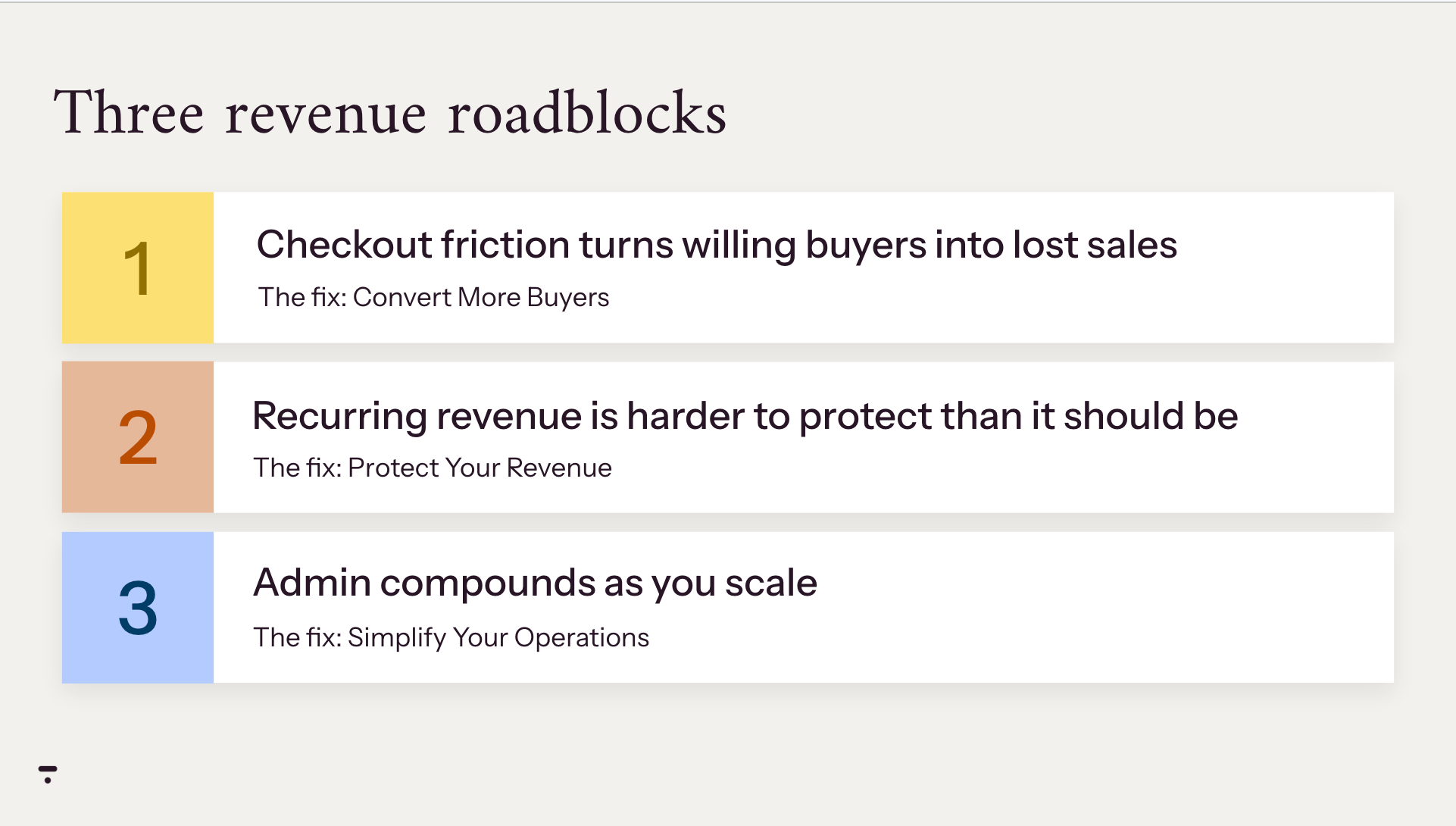
The tools that address each of these three areas are all available through Thinkific Payments, Thinkific’s built-in payment processor. Keep reading to learn what each one looks like, and what you can do about it.
Opportunity 1: Convert more buyers at checkout
The buyers who are almost there
Checkout optimization isn’t about finding new audiences. It’s about converting the buyers who are already there, and ready to purchase.
Picture this: An international learner lands on your checkout page, sees a price in USD, and has to calculate the local equivalent. Some complete the mental math and proceed. Others hesitate and close the tab. A corporate training manager wants to enroll 20 employees before a compliance deadline. Without a way to purchase multiple seats in one transaction, they either buy individually, request a manual invoice, or look elsewhere. A buyer gets to the cart, gets pulled away, and never returns.
In each case, the intent was there. The checkout experience is what determined whether that intent turned into revenue.
The fixes
- Local currency at checkout shows international buyers the price in their own currency, converted at live exchange rates. Over 75% of buyers choose to pay in local currency when it’s available, with measurable improvement in checkout completion. Removing the mental math removes the hesitation.
- Group Orders lets a corporate or team buyer purchase multiple seats in a single transaction. They choose the quantity at checkout, complete one purchase, and manage seat assignments through a dedicated dashboard. For customer education programs and training businesses selling to organizational buyers, this removes the friction that causes bulk deals to stall.
- Abandoned cart recovery gives you a follow-up path when a buyer doesn’t finish. Thinkific sends an automated email one hour after abandonment with a direct link back to checkout.
- Order Bumps increase the value of every transaction by presenting a relevant add-on at the moment of purchase. Businesses using Order Bumps see a 20% larger average transaction size.
Opportunity 2: Protect and stabilize recurring revenue
The churn that has nothing to do with your content
Subscription churn from your learning products is rarely just a content or engagement problem. One of the most common causes is simpler and less visible: the payment failed, the system retried once, and no one caught it.
The outcome looks like churn, but the root cause was a billing failure that could have been resolved in minutes with the right automation in place. For learning products managing renewals manually, in spreadsheets or external CRMs, the visibility to catch these failures before they compound doesn’t exist and can have a negative impact.
The fixes
- Payment Failed Notification sends an automated email the moment a subscription charge fails, with a direct link for the subscriber to update their card.
- Upcoming Renewal Reminder addresses a different type of churn: the cancellation that happens because a charge felt like a surprise. Sending subscribers an automated heads-up before their renewal date gives them time to decide, update their payment details, or ask a question.
- Smart Retries analyzes signals to determine when a retry is most likely to succeed and reattempts automatically at that moment. On average, Smart Retries recovers 30% more revenue than a single-retry approach.
Opportunity 3: Reclaim the time that compounds as you scale
What admin overhead actually costs
Manual administrative work scales poorly. At 50 learners, reconciling billing data across two systems is manageable. At 500, it’s a meaningful time cost. At 5,000, it’s someone’s job. The hours are the visible cost. The invisible one is what your team could be doing with that time instead.
When administrative work runs automatically, your team’s attention can go back to the things that compound: stronger programs, more content, better learner support. That reallocation is often worth more than the time itself.
The fixes
- Consolidated Payments View puts every transaction for a learner in one place inside Thinkific: orders, subscriptions, payment plans, and refunds, all on one screen. When a learner writes in with a billing question, the answer is in their profile.
- Improve checkout attribution by connecting Google Analytics 4 and Meta Pixel directly to your Thinkific checkout. Purchase data flows accurately into the platforms where you’re running ads, so you can see which campaigns are actually driving revenue rather than spending based on assumptions.
- Email Validation at Checkout catches typos before a purchase completes.The buyer is prompted to fix the error before they submit so your support queue stays quiet.
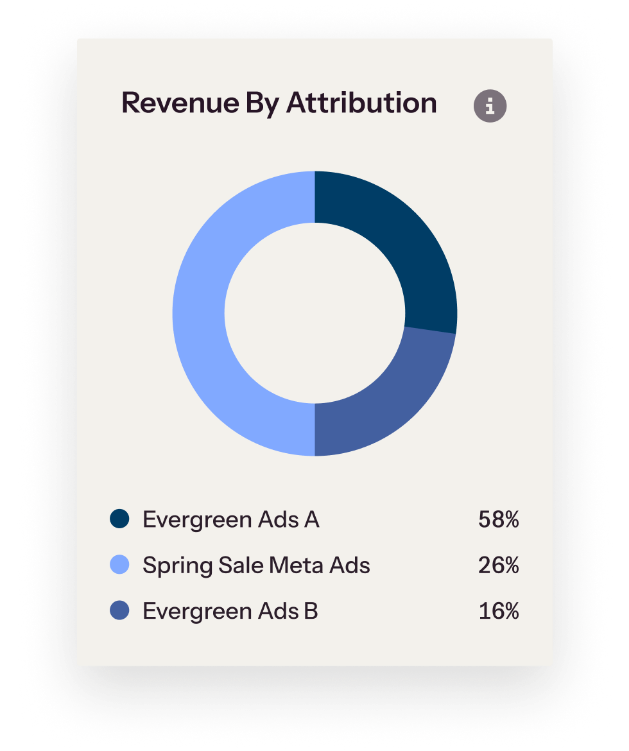
Z-Health removed their accounts receivable role entirely after moving to Thinkific Payments.
“The team is spending time on bigger-picture things for the business,” Kalajian says. They used the recovered capacity to create more free courses, build a YouTube channel, and develop lead magnets. The administrative overhead hadn’t just cost hours. It had delayed the growth work.
The bigger picture
Each of these three optimizations is worth pursuing on its own. But what makes them valuable together is what they unlock.
These fixes aren’t just about stopping losses. They’re setting you up for success before your next stage of growth.
Run your education business on Thinkific Payments
Thinkific Payments is Thinkific’s built-in payment processor, while TCommerce is the broader commerce suite that includes features like Group Orders, Order Bumps, Subscription Management, and Smart Retries. Turning on Thinkific Payments unlocks every TCommerce tool covered in this piece, and it takes just a few minutes to set up in your payments settings.
The question isn’t whether these gaps exist in your business. It’s which ones are costing you the most right now.
Take the Revenue Health Check to find out where your revenue is leaking and which fix to activate first.